


Figures 7a and 7b
show the distributions of the scaled electron
density, assuming the  dependence determined above, respectively
southward and northward of
dependence determined above, respectively
southward and northward of  . The data are binned over
  .
In the southern hemisphere, the mean of the histogram is
.
In the southern hemisphere, the mean of the histogram is  and its median
  , with a standard deviation of
  .
Since the histogram shape suggests a
normal distribution, we fitted to our data a Gaussian distribution
(solid line),
which is centered at
.
Since the histogram shape suggests a
normal distribution, we fitted to our data a Gaussian distribution
(solid line),
which is centered at  . We find slightly smaller values
for the northern
hemisphere, where the mean of the histogram is
. We find slightly smaller values
for the northern
hemisphere, where the mean of the histogram is  and its median
 , with a standard deviation of
  , whereas
the fitted Gaussian distribution has a mean of
, whereas
the fitted Gaussian distribution has a mean of  .
The northern hemisphere is thus about 8% less dense than the southern one,
and this
confirms the asymmetry of
the power law indices found in section 3.
.
The northern hemisphere is thus about 8% less dense than the southern one,
and this
confirms the asymmetry of
the power law indices found in section 3.
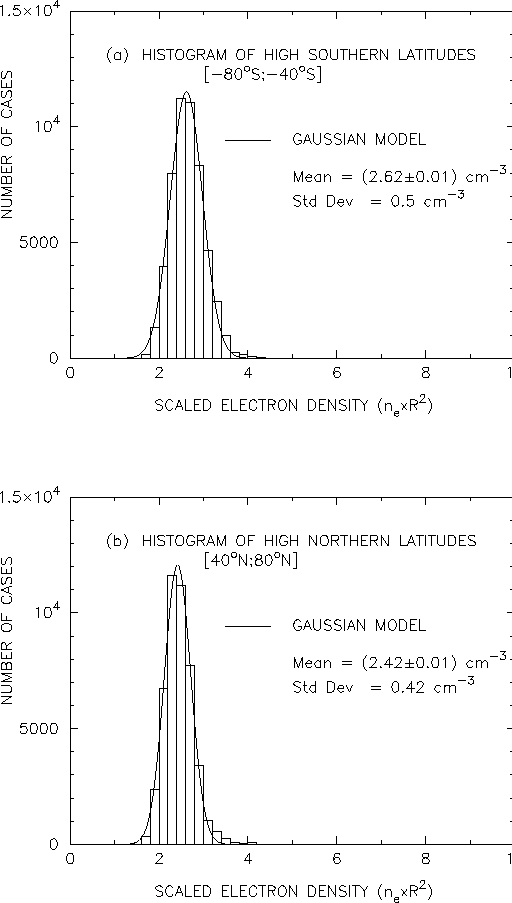
Figure 7: Histogram of the electron density poleward of , scaled to 1 AU
assuming
an dependence; the bin size is . The measured
distribution
is centered at (a) at northern latitudes and at
(b) at southern latitudes
(other cumulants are shown in Table 2),
showing a 8% asymmetry between the two hemispheres. The solid line is the
Gaussian which fits best the data.
Note that the mean value of each density histogram is slightly lower than that deduced from a preliminary analysis [Issautier et al., 1997]. (This would remain true even if the same latitude ranges had been chosen in both analyses.) This is because the present data are obtained using a more sophisticated analysis of the QTN spectra which now takes into account the drift velocity and is thus better adapted for high-speed stream measurements. It gives about 20,000 more measurements from pole-to-pole than the previous analysis.
Figures 8a and 8b
represent the histograms of the scaled core temperature,
using a bin size of 3400 K and assuming the  law found above,
poleward of .
The south
histogram is centered at
law found above,
poleward of .
The south
histogram is centered at  K while
the north one is
centered at
K while
the north one is
centered at  K, i.e., the electrons in the northern
hemisphere are about 7% colder than in the southern one.
We fitted each histogram with a single
normal distribution, which has quite
the same mean and standard deviation, given in Figures 8a and
8b,
as the observed histograms (see Table 3).
This confirms that the core temperature distributions are roughly normal
as are those of the density.
K, i.e., the electrons in the northern
hemisphere are about 7% colder than in the southern one.
We fitted each histogram with a single
normal distribution, which has quite
the same mean and standard deviation, given in Figures 8a and
8b,
as the observed histograms (see Table 3).
This confirms that the core temperature distributions are roughly normal
as are those of the density.
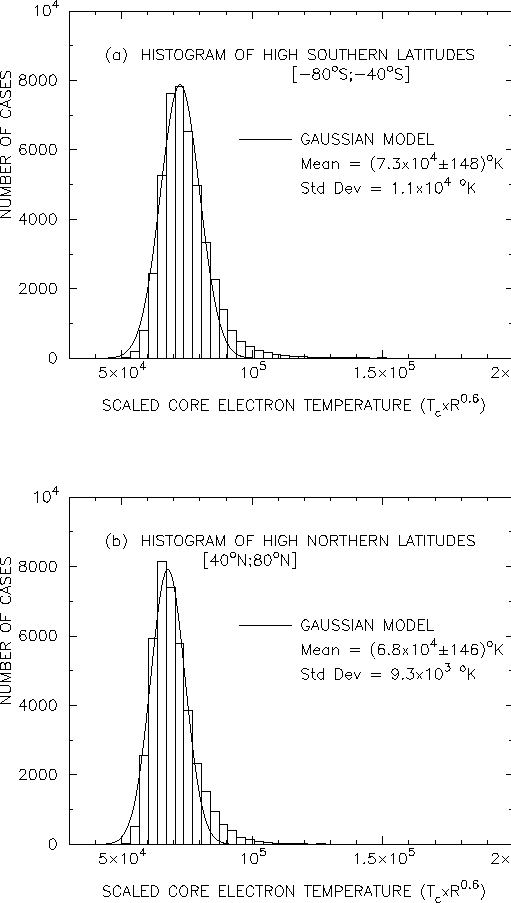
Figure 8: Histogram of the core temperature poleward of , scaled to 1 AU
assuming a variation;
the bin size is 3400 K. The measured distribution is
centered at K for high southern latitudes (a)
and at K for high northern latitudes (b), showing a 7%
difference (other cumulants are given in Table 3).
The solid line is the
gaussian which fits best the data.