


Since the electron core population is roughly Maxwellian with a small anisotropy in its proper frame [see, e.g., Feldman et al., 1975], we can approximate its tensor pressure by a scalar. Hence the radial momentum balance can be approximated by

Here  is the electrostatic potential,
  is the
difference in radial bulk velocity between the core
electrons and the protons,
is the
difference in radial bulk velocity between the core
electrons and the protons,  is the electron-proton collision
frequency for momentum transfer, and k, e and
is the electron-proton collision
frequency for momentum transfer, and k, e and  are respectively
the Boltzmann's constant, the elementary charge, and the electron
mass. We neglected the small inertia and gravitational
terms and the contribution of wave interactions to the momentum
balance.
are respectively
the Boltzmann's constant, the elementary charge, and the electron
mass. We neglected the small inertia and gravitational
terms and the contribution of wave interactions to the momentum
balance.
With  and
and  , and
neglecting the collisional term,
(1) yields
, and
neglecting the collisional term,
(1) yields

Putting  and
and  K yields the electrostatic
field at 1 AU
K yields the electrostatic
field at 1 AU

This polarization field, which is directed outward and accelerates the protons, produces a potential barrier for the electrons that the escaping ones have to overcome. As predicted by kinetic theories, it is larger than the Pannekoek-Rosseland electric field which would ensure charge quasi-neutrality in hydrostatic isothermal equilibrium

(and to its generalization for unequal temperatures); here  ,
,
 , and G are respectively
the proton and solar mass and the gravitational
constant. So large a potential is required
in order to reduce the electron escape flux
which would otherwise be much larger than the proton flux since
their thermal velocity is much larger than that of the protons
(see, e.g., [Lemaire & Scherer, 1971]).
, and G are respectively
the proton and solar mass and the gravitational
constant. So large a potential is required
in order to reduce the electron escape flux
which would otherwise be much larger than the proton flux since
their thermal velocity is much larger than that of the protons
(see, e.g., [Lemaire & Scherer, 1971]).
Note also that this interplanetary field is of the same order as the ``run-away field" (see, e.g., [Dreicer, 1959])

where  is the core electron mean
free path in SI units {[Spitzer , 1962].
is the core electron mean
free path in SI units {[Spitzer , 1962].
Although our result was obtained from a simplified fluid equation, it is interesting to compare it with the predictions of solar wind kinetic theories. We find a polarization electric field at 1 AU equal to about 3.5 times the Pannekoek-Rosseland field. This is close to the values found by Lemaire and Scherer [1971]; the same is true for the generalization of these results to non-Maxwellian distributions by Maksimovic et al. [1997].
If the index  did hold up to large distances, we
might
integrate (2) to obtain the interplanetary potential
at 1
AU
did hold up to large distances, we
might
integrate (2) to obtain the interplanetary potential
at 1
AU

This value is close to typical estimates in high-speed streams
[Feldman et al., 1978b].
(Note also that the isothermal Pannekoek-Rosseland potential at 1 AU
is, from (4),  .)
The contribution of this potential to the solar wind acceleration
up to large distances is given by
.)
The contribution of this potential to the solar wind acceleration
up to large distances is given by 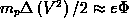 , which yields a
relative increase in velocity of
, which yields a
relative increase in velocity of  . With
  km/s [Phillips et al., 1995a] this gives
 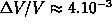 ,
which is
negligible.
,
which is
negligible.
Finally, let us estimate the importance of the neglected collision term in the momentum balance. The ratio of this term to the pressure gradient is given by

where we substituted by  with
with
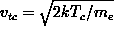 . For
an upper estimate of the radial velocity lag of the core
electrons, we take the local Alfven speed, as suggested by the
data of Feldman et al. [1975], i.e.,
. For
an upper estimate of the radial velocity lag of the core
electrons, we take the local Alfven speed, as suggested by the
data of Feldman et al. [1975], i.e.,
 with
with
 T (extrapolated at 1 AU from [Forsyth et al., 1996],
and we use the 1 AU
values of n and
T (extrapolated at 1 AU from [Forsyth et al., 1996],
and we use the 1 AU
values of n and  determined above in the southern high-speed wind. This yields a
collisional term of order 3% of the pressure term, which
justifies the approximation made. Note that the velocity
difference may be larger [Scime et al., 1994], so that this term might
no longer be negligible,
making the true electrostatic field larger than the above
estimate.
determined above in the southern high-speed wind. This yields a
collisional term of order 3% of the pressure term, which
justifies the approximation made. Note that the velocity
difference may be larger [Scime et al., 1994], so that this term might
no longer be negligible,
making the true electrostatic field larger than the above
estimate.