


The results obtained in the southern hemisphere suggest a lack of latitudinal
variations there. This is in agreement with the small
value of the electron density latitudinal
gradient reported by
[Issautier et al., 1997]. Note that such an
independence from latitude was also found,
for example,
for the radial magnetic field scaled to  , poleward of 40
  [Forsyth et al., 1996].
In contrast, the high value of the density
power index, with respect to 2, obtained at high northern latitudes
suggests that the data in that hemisphere exhibit not only a
radial variation but also
a latitudinal and/or temporal variation.
[Forsyth et al., 1996].
In contrast, the high value of the density
power index, with respect to 2, obtained at high northern latitudes
suggests that the data in that hemisphere exhibit not only a
radial variation but also
a latitudinal and/or temporal variation.
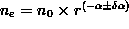 | 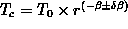 | ||||||
| Hemisphere |  |  |  |  |  |
 | |
| Southern | 2.003 |  |  | 0.64 |  |  K K | |
| Northern | 2.36 |  |  | 0.83 | 
|  K K | |
This north-south asymmetry might be due to a genuine solar asymmetry, as suggested for example by coronal observations; for instance, the northern coronal hole was larger than the southern one during Ulysses fast transit. However, it may also be due to a temporal variation since the measurements were made over nearly one year during the declining solar cycle toward minimum. Anyway, this point is difficult to settle; using in-ecliptic measurements, [Schwenn, 1983] found indeed long-term temporal variations of the same order of magnitude in the average solar wind, but this may reflect the variation in the occurrence rate of different types of flow instead of genuine variations of the high-speed wind proper.