


The two sets of solar wind data obtained
in the steady high-latitude regions determined above,
(>  south and north, respectively), a priori depend on the
heliocentric distance and latitude of Ulysses and possibly on temporal
variations in solar activity. Nevertheless, if we expect that the expansion of
the solar wind in these regions has a spherical symmetry
and has no large-scale temporal or latitudinal variations
in the observing time range (of
about 4 months each), we
should find that the density decreases as a power law:
south and north, respectively), a priori depend on the
heliocentric distance and latitude of Ulysses and possibly on temporal
variations in solar activity. Nevertheless, if we expect that the expansion of
the solar wind in these regions has a spherical symmetry
and has no large-scale temporal or latitudinal variations
in the observing time range (of
about 4 months each), we
should find that the density decreases as a power law:
 since the radial variation in bulk velocity is very small in high-speed wind
(see, e.g., [Arya & Freeman, 1991]).
To analyze such a basic trend of the density variation with heliocentric
distance, we used a linear regression method using the two full density data
sets in logarithmic scales as shown in the lower part of
Figures 5a and 5b. As compared with a
linear regression on binned data, this method has the advantage of avoiding
an arbitrary choice of the bin size and locations, while averaging as
well short term variations of the data.
since the radial variation in bulk velocity is very small in high-speed wind
(see, e.g., [Arya & Freeman, 1991]).
To analyze such a basic trend of the density variation with heliocentric
distance, we used a linear regression method using the two full density data
sets in logarithmic scales as shown in the lower part of
Figures 5a and 5b. As compared with a
linear regression on binned data, this method has the advantage of avoiding
an arbitrary choice of the bin size and locations, while averaging as
well short term variations of the data.
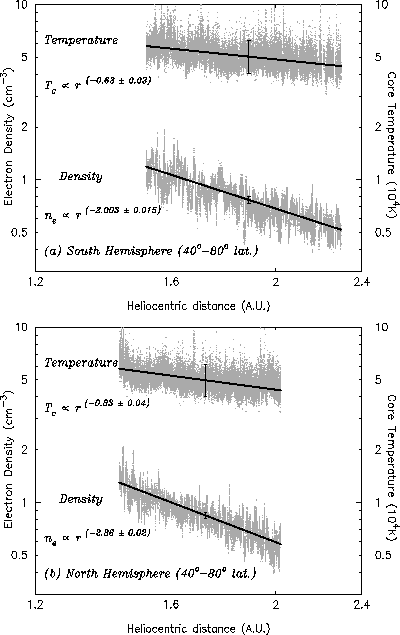
Figure 5: Radial variations of the electron density and core temperature at
high latitudes in both solar hemispheres. The solid lines are the best fit
power laws to
the data whose parameters are shown in Table 1. The vertical bars are the
standard deviations  and
and  ,
determined by the specific fitting used in
QTN spectroscopy, on the electron density and core temperature respectively
(see section 3.1).
Note that southward of
there
are about 53,000 data points, whereas there are about 46,000 data points
northward of .
,
determined by the specific fitting used in
QTN spectroscopy, on the electron density and core temperature respectively
(see section 3.1).
Note that southward of
there
are about 53,000 data points, whereas there are about 46,000 data points
northward of .
Let us note that such a method can be performed because our data sets have no significant measurement gaps and have not been selected on any arbitrary criterion among the raw data.
We processed the linear regression by minimizing the corresponding
 merit function defined by

with  , where is the
uncertainty on each electron density logarithm provided by the
specific measurement method of QTN spectroscopy reviewed in section 2. Indeed,
we do not compute the with
, where is the
uncertainty on each electron density logarithm provided by the
specific measurement method of QTN spectroscopy reviewed in section 2. Indeed,
we do not compute the with  because we need to take into account the
actual short scale
variations of the density (with respect to the observing interval),
associated for instance to the solar rotation; these variations are
represented by the standard deviation of the density
(shown in Figure 4)
which is about three times larger than the measurement
uncertainties .
because we need to take into account the
actual short scale
variations of the density (with respect to the observing interval),
associated for instance to the solar rotation; these variations are
represented by the standard deviation of the density
(shown in Figure 4)
which is about three times larger than the measurement
uncertainties .
This method thus provides the slope -  , which is the power law index of
the variation of
, which is the power law index of
the variation of  , and
, and  , where
  is
the density extrapolated to 1 AU; it also provides uncertainties
is
the density extrapolated to 1 AU; it also provides uncertainties
 and
and  depending on the variation (
  ) around its minimum. Indeed, the analysis shows a
strongly
anticorrelated error-ellipse (not shown) between the intercept and the slope
of the log-log fit; in order to give uncertainties with a maximum
confidence level, we have derived and
by setting the to 18.4, which corresponds to
99.99% of the probability distribution for two fitted parameters varying
jointly [Press et al., 1992]
) around its minimum. Indeed, the analysis shows a
strongly
anticorrelated error-ellipse (not shown) between the intercept and the slope
of the log-log fit; in order to give uncertainties with a maximum
confidence level, we have derived and
by setting the to 18.4, which corresponds to
99.99% of the probability distribution for two fitted parameters varying
jointly [Press et al., 1992]
The result for the southern hemisphere data is very close to that we
expected:  ; it is thus compatible
with our initial assumption of
independence on latitude or time.
In contrast, the power law index
obtained in the northern hemisphere,
; it is thus compatible
with our initial assumption of
independence on latitude or time.
In contrast, the power law index
obtained in the northern hemisphere, 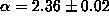 , suggests that this
northern
density is dependent on latitude and/or time.
, suggests that this
northern
density is dependent on latitude and/or time.
We also processed the ditto linear regression method to our
temperature measurements as
shown in the top part of Figures 5a and 5b, in order
to estimate the core electron temperature variation with heliocentric distance
in both hemispheres as a power law:  .
In this case, the standard deviation of the core temperature is of the same
order as the
measurements uncertainties , which are thus
used to evaluate the
uncertainty on the slope
.
In this case, the standard deviation of the core temperature is of the same
order as the
measurements uncertainties , which are thus
used to evaluate the
uncertainty on the slope  in the same manner as above; i.e.,
 .
Southward of we obtain a power index
.
Southward of we obtain a power index 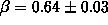 ,
while
,
while  0.83 northward of , showing an asymmetry
already noted
for the density index values (see Table 1 for a summary of
the results).
Since we can consider from our linear regression on the density that the
southern
data set is a good sample of stationary high-speed
solar wind in spherical expansion, we conclude
that the core electron temperature variation with heliocentric distance
in such a steady wind can be described by the power law
0.83 northward of , showing an asymmetry
already noted
for the density index values (see Table 1 for a summary of
the results).
Since we can consider from our linear regression on the density that the
southern
data set is a good sample of stationary high-speed
solar wind in spherical expansion, we conclude
that the core electron temperature variation with heliocentric distance
in such a steady wind can be described by the power law
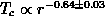 between 1.52 and 2.31 AU.
This result is obtained with
between 1.52 and 2.31 AU.
This result is obtained with  and N=52,644 data points,
which gives a goodness-of-fit probability very close to 1;
(such a good value suggests
that the measurement errors might have been slightly overestimated).
Hereafter, we will use this law
to scale our measured core electron temperatures, and the
and N=52,644 data points,
which gives a goodness-of-fit probability very close to 1;
(such a good value suggests
that the measurement errors might have been slightly overestimated).
Hereafter, we will use this law
to scale our measured core electron temperatures, and the  law to scale the densities.