


Figure 4 shows the standard deviations of the total electron
density and
core temperature,
 and
and  ,
normalized respectively to
,
normalized respectively to  and
and  , displayed as functions of the
heliolatitude. The data have been first half-daily averaged
in order to
eliminate
small-scale fluctuations. As
Ulysses explored the equatorial band
in about 2 solar rotations,
it crossed seven times the warped current sheet [Smith et al., 1995]
yielding about four sectors.
So, during the whole transit we calculated the standard deviations
over latitude bins of
, displayed as functions of the
heliolatitude. The data have been first half-daily averaged
in order to
eliminate
small-scale fluctuations. As
Ulysses explored the equatorial band
in about 2 solar rotations,
it crossed seven times the warped current sheet [Smith et al., 1995]
yielding about four sectors.
So, during the whole transit we calculated the standard deviations
over latitude bins of  , which on average corresponds
to 7-day intervals in the equatorial band.
, which on average corresponds
to 7-day intervals in the equatorial band.
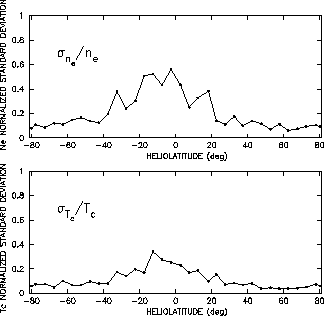
Figure 4: Normalized standard deviation of (top) electron density and
(bottom) core
temperature plotted against the heliolatitude from pole-to-pole.
The data are binned over latitude intervals of as explained in the text.
The plot reveals
an abrupt change of regime at  S and
S and  N,
which characterizes two latitudinal regions, and shows the
small constant value of the
standard deviations poleward of
N,
which characterizes two latitudinal regions, and shows the
small constant value of the
standard deviations poleward of  .
.
Figure 4 clearly shows an
abrupt change of regime
at S and
N. Poleward of these latitudes, the normalized standard deviation
in both parameters is much lower than in the equatorial
band, except near  S due to the brief excursion
into the streamer belt type wind. However, the smallest values of the standard
deviations are measured poleward of ,
where the normalized standard deviation of
remains in the range
0.10 to 0.17 while the normalized standard deviation of is less than
0.12.
Note that these standard deviations are smaller
in the northern hemisphere than in the southern one; this
may be
due to a solar asymmetry or possibly to
the slight decrease of the solar activity during the 10-month observing
interval.
Our analysis suggests to study the
radial profiles of the electron density and core temperature when
S due to the brief excursion
into the streamer belt type wind. However, the smallest values of the standard
deviations are measured poleward of ,
where the normalized standard deviation of
remains in the range
0.10 to 0.17 while the normalized standard deviation of is less than
0.12.
Note that these standard deviations are smaller
in the northern hemisphere than in the southern one; this
may be
due to a solar asymmetry or possibly to
the slight decrease of the solar activity during the 10-month observing
interval.
Our analysis suggests to study the
radial profiles of the electron density and core temperature when
 and
and  are minimum, i.e.,
poleward of .
are minimum, i.e.,
poleward of .