

ERC Consolidator Grant #101230218 | PI: Johan Mazoyer
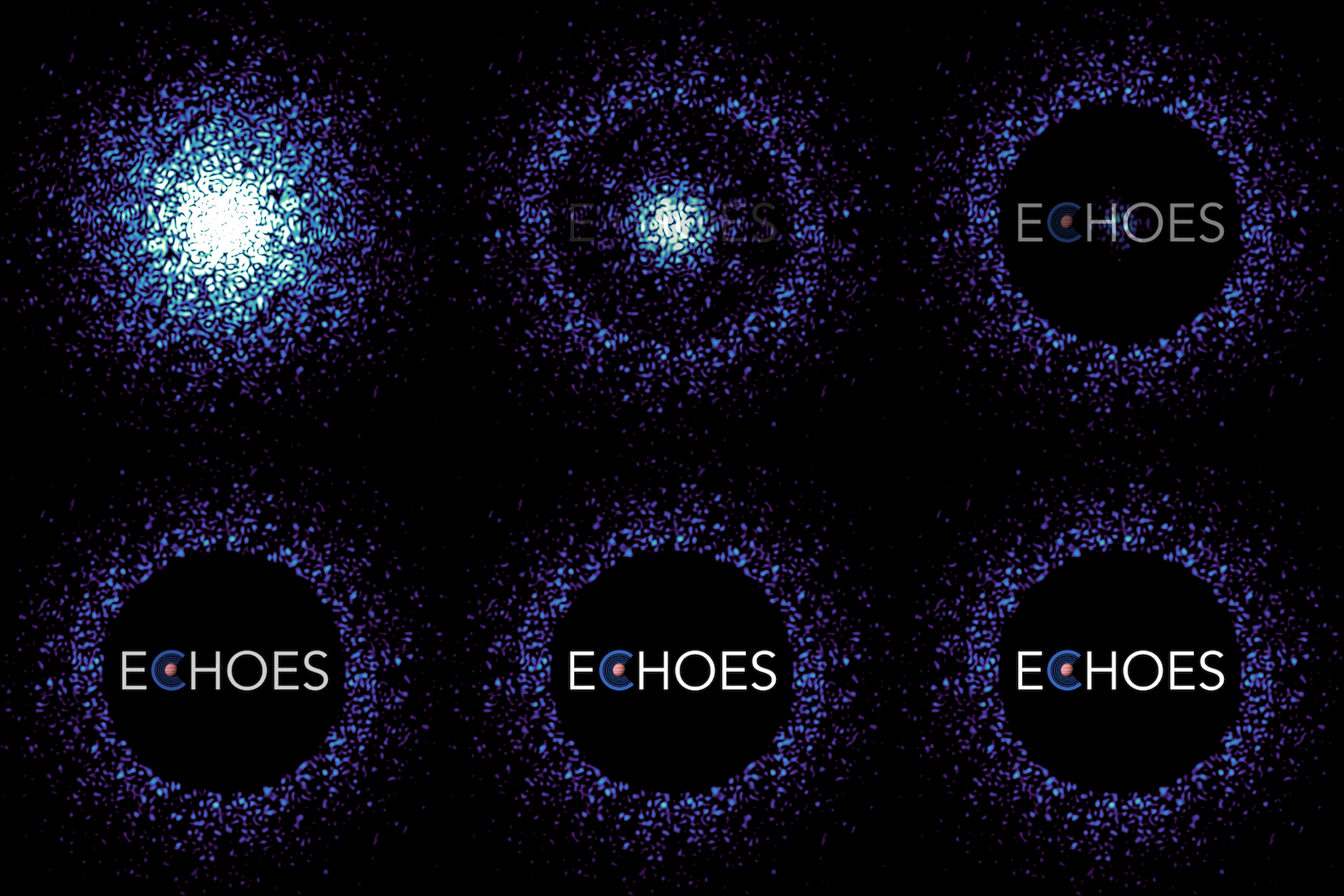
The transit method currently dominates exoplanet discovery but is limited to short-period, transiting planets, offering only partial insights into habitable zone planets. Direct imaging, particularly through coronagraphic imaging, presents the most promising approach for characterizing habitable zone exoplanets and their atmospheres. Future missions like NASA's Habitable Worlds Observatory (HWO) and ELT instruments, such as the Planetary Camera & Spectrograph (PCS), aim to overcome this challenge, targeting habitable zone planets around Sun-like and M-dwarf stars, respectively. However, coronagraphic imaging faces significant obstacles due to the extreme star-planet flux ratios. To limit the risks faced by PCS and HWO, ESO and NASA have initiated two technology demonstrators, VLT/SPHERE+ (2027) and Roman mission (2026).
They will validate innovative active wavefront correction methods, key to improve coronagraphic performance. As of today, current coronagraphs instruments have uncovered only a handful of young giant planets. But radial velocity surveys suggest most giant planets orbit closer (5–10 au), currently right at the limit of our instruments' capability. The upcoming Gaia release (2026) will provide hundreds of possible targets. The positioning SPHERE+, a technology demonstration with cutting edge performance, is a unique opportunity to address a dual goal:
- Astrophysical: Imaging already indirectly detected YGPs using the novel "dark-hole" technique
- Instrumental: Developing faster active wavefront correction methods and image treatment
The methods developed through this ERC are unexplored and have been specifically chosen to be relevant for ground and space instruments. They will be tested on SPHERE+, serve as a foundation for the design of ELT/PCS, and could be used on Roman, with a long-term goal of direct use for HWO. Finally, a key deliverable is to provide an experimental platform for PCS & HWO technology demonstration, open to European researchers for collaboration.

THD 2
The Très haute dynamique (THD2) testbed in Paris is the only R&D facility of this kind in Europe, achieving the second-highest contrast in the world. It is the perfect environment to perform the experimental validations proposed in this ERC.
SPHERE+
SPHERE+ is an upgrade of the instrument SPHERE installed at the Very Large Telescope in Chile (ESO) since 2015. The limitations of SPHERE are now well understood. SPHERE+ has the objective to explore the 3-10 au region around nearby stars, where the bulk of the giant planet population is expected to be located. SPHERE+ is developed by a large European consortium in coordination with the ESO technology development group and will serve as a demonstrator for the PCS, a second generation coronagraphic instrument of the ELT.