


When a passive electric antenna is immersed in a stable plasma, the thermal
motion of the ambient particles produces electrostatic fluctuations, which are
completely determined by the particle velocity distributions. This
quasi-thermal noise can be
measured at the terminals of an antenna connected to a sensitive radio receiver;
the analysis of the voltage power spectrum enables us to measure in situ
plasma parameters [Meyer-Vernet & Perche, 1989]
It yields an accurate determination of the electron density
since the electron thermal motions excite Langmuir waves, which produce a
spectral peak just above the plasma frequency  . Moreover, the electrons
passing around the antenna induce voltage pulses on it,
producing above
a noise level which decreases as the observing frequency increases
and a plateau just below this
frequency. The spectrum level and the shape on
both sides of give the bulk temperature.
The method is currently being generalized [Issautier et al., 1996]
to measure the plasma bulk speed. Because the proton
thermal velocity is much smaller than the plasma bulk velocity, the proton
noise spectrum is strongly Doppler-shifted, and it can be observed far above the
proton characteristic frequencies.
The solar wind speed is thus deduced from the
analysis of the proton contribution to the low-frequency thermal spectrum.
. Moreover, the electrons
passing around the antenna induce voltage pulses on it,
producing above
a noise level which decreases as the observing frequency increases
and a plateau just below this
frequency. The spectrum level and the shape on
both sides of give the bulk temperature.
The method is currently being generalized [Issautier et al., 1996]
to measure the plasma bulk speed. Because the proton
thermal velocity is much smaller than the plasma bulk velocity, the proton
noise spectrum is strongly Doppler-shifted, and it can be observed far above the
proton characteristic frequencies.
The solar wind speed is thus deduced from the
analysis of the proton contribution to the low-frequency thermal spectrum.
Practically, a plasma diagnostic is performed by (1) assuming a model of the velocity distribution (we describe the distribution of the electrons by the superposition of a cold (c) and a hot (h) Maxwellian [Feldman et al., 1975] and that of the protons by one drifting Maxwellian), (2) calculating the theoretical spectrum produced by these distributions, and (3) deducing the parameters of the model by fitting the theory to the data.
The observations were performed with the URAP radio receiver [Stone et al., 1992] connected to the 2 x 35 m electric thin dipole antenna located in the spacecraft spin plane. The receiver is linearly swept through 64 equally spaced frequency channels (of bandwidth 0.75 kHz and duration 2 s), covering the low-frequency band from 1.25 to 48.5 kHz in 128 s. This receiving mode is well suited to measure plasma thermal noise spectra on Ulysses with a good frequency resolution.
Figure 1 shows a typical example of the observed voltage
power spectrum.
The solid line represents the best fit of
the theoretical electron-plus-proton QTN to the observed spectrum;
the fit is good since the  is less than 2%. The model
fitting yields
the total electron density
is less than 2%. The model
fitting yields
the total electron density  , deduced from the plasma line,
the core electron temperature
, deduced from the plasma line,
the core electron temperature  , the proton bulk speed V and
temperature
, the proton bulk speed V and
temperature  , and the electron suprathermal
parameters
, and the electron suprathermal
parameters  ,
,  . The latter parameters
have large statistical uncertainties
(which are obtained from the fitting procedure)
because suprathermal particles are
revealed by the detailed shape of the spectral
peak [Chateau & Meyer-Vernet, 1991]
whose measurement requires a better
frequency resolution.
Preliminary results on the solar wind speed
generally give a precision of 10-30% on it depending on the latitude.
The best accuracy is obtained for the total electron
density which is known with an accuracy of
a few percent since it is derived from the measurement of a
frequency and is thus independent of the receiver gain
calibration,
and on the core temperature on which the uncertainty is generally smaller
than 10% for in-ecliptic measurements and better than 25% at high latitude.
It is noteworthy that the uncertainty on is now better than
when the drift velocity is
neglected [Meyer-Vernet et al., 1997]
. The latter parameters
have large statistical uncertainties
(which are obtained from the fitting procedure)
because suprathermal particles are
revealed by the detailed shape of the spectral
peak [Chateau & Meyer-Vernet, 1991]
whose measurement requires a better
frequency resolution.
Preliminary results on the solar wind speed
generally give a precision of 10-30% on it depending on the latitude.
The best accuracy is obtained for the total electron
density which is known with an accuracy of
a few percent since it is derived from the measurement of a
frequency and is thus independent of the receiver gain
calibration,
and on the core temperature on which the uncertainty is generally smaller
than 10% for in-ecliptic measurements and better than 25% at high latitude.
It is noteworthy that the uncertainty on is now better than
when the drift velocity is
neglected [Meyer-Vernet et al., 1997]
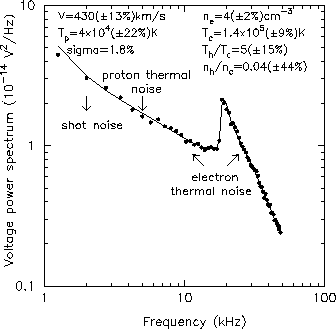
Figure 1: Example of voltage power spectrum (in  )
measured with the URAP dipole antenna on Ulysses at 1.34 AU heliocentric
distance.
The solid line is the
theoretical spectrum of the
electron plus proton quasi-thermal noise (plus shot noise) which
best fits the data (dots), with the plasma parameters shown.
)
measured with the URAP dipole antenna on Ulysses at 1.34 AU heliocentric
distance.
The solid line is the
theoretical spectrum of the
electron plus proton quasi-thermal noise (plus shot noise) which
best fits the data (dots), with the plasma parameters shown.
Note that in the following section we selected the core temperature and the electron density data for which the fitting of the voltage power spectrum to the observations (see Figure 1) is the best; i.e., the sigma of the fit is better than 2.5%.