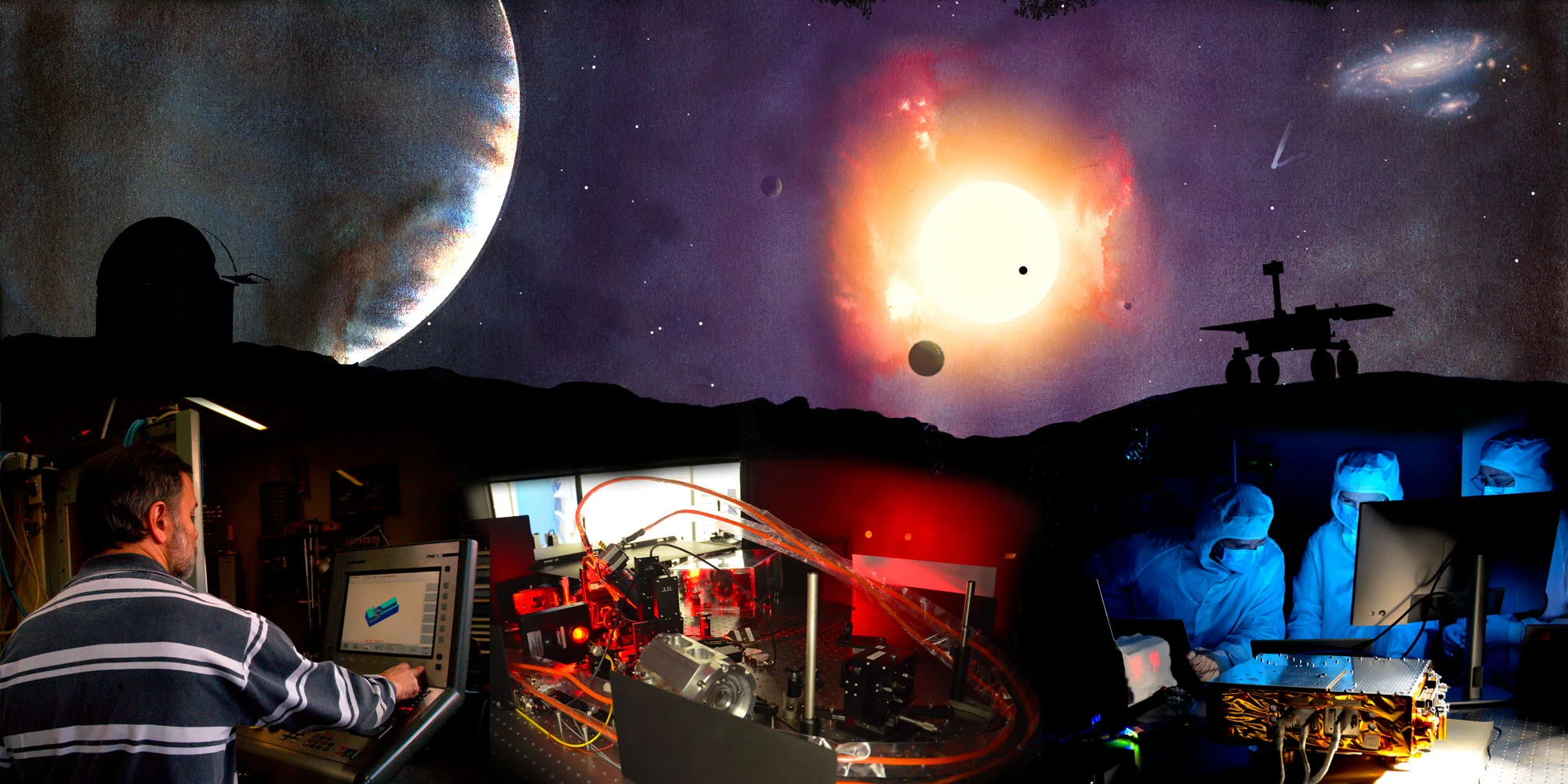
Exoplanet direct imaging allows us to directly probe and characterize an exoplanet’s atmosphere. The goal is to one day directly image a rocky planet in the habitable zone of its host star. This will allow us to search for signs of life in its atmospheric signatures and begin answering questions about our place in the Universe. However, such direct characterization has been unlocked for only a handful of the most massive planets on the widest orbits thus far. In order to understand how these massive substellar companions form and evolve, we need to analyze trends in the population demographics. Studying directly imaged substellar companions as a population is difficult because of the technological challenges faced in detecting them combined with their rare existence.
To address the challenge of searching for these rare substellar companions, I will present ongoing ground-based direct imaging surveys of young, nearby, low-mass stars, searching for exoplanet and brown dwarf companions. I will also present ongoing technology developments to extend direct imaging to the lower mass, and more abundant, planet populations. However, directly imaging an Earth-like planet around a Sun-like star requires reaching 10^-10 contrast levels and will be the goal of the Habitable Worlds Observatory (HWO), NASA’s next flagship mission.
A key technical barrier to reaching such deep contrasts is maintaining wavefront stability on the order of tens of picometers, in particular, in the presence of a segmented primary mirror. Keck Observatory is the only facility with all of the hardware components necessary for validating HWO segment phasing strategies, namely a large segmented primary mirror, capacitive edge sensors, deformable mirror, Zernike wavefront sensor (ZWFS), and high contrast science instruments. Taking advantage of these parallels, we are using Keck Observatory as an HWO testbed for developing and validating wavefront sensing and control schemes. I will present our ongoing segment phasing results using the ZWFS on Keck, in the context of high-contrast imaging.
Exoplanet Imaging with Large Segmented Telescopes
Jeudi 26 mars 2026
de
11:00 à
12:00
Bâtiment 16, Salle de réunion 207
