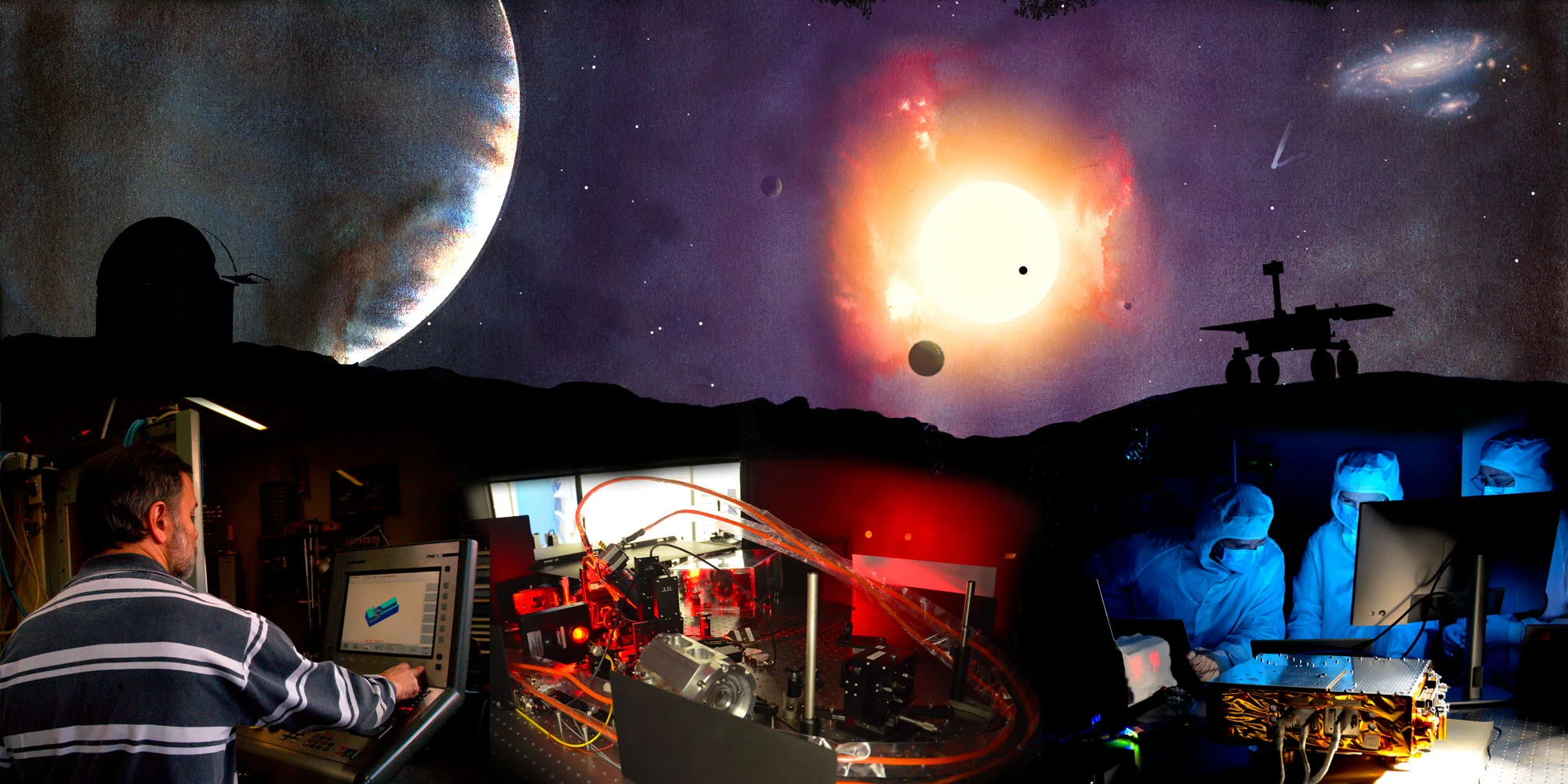
The Rosalind Franklin Rover will explore the Oxia Planum region on Mars to search for traces of ancient life. To assess the rover instruments’ ability to detect biosignatures, the mission science team has conducted a scientific campaign by analyzing a set of peer-review-selected Mars analog samples. This presentation reports results obtained with a lab replica of the Mars Organic Molecule Analyzer (MOMA) and lessons learnt for optimizing the analysis of samples during the mission.
Our study characterized organic molecules present in analogue samples using a gas chromatography mass spectrometry protocol like MOMA’s. We simulated MOMA pyrolysis and explored the effect that the highest temperature reached has on the nature of the volatiles. We also applied MOMA’s three chemical reagents to the samples to extract organic molecules of astrobiological interest, such as amino acids. Our work demonstrates that, to optimally release volatiles from samples, two pyrolysis temperatures are required. The low temperature pyrolysis liberates the first evolving compounds without exposing them to high temperature transformations, while the second pyrolysis is able to draw out molecules trapped in more refractory minerals.
Our analysis also proved that MOMA can reliably detect prebiotic molecules. The pyrolysis and derivatization techniques we used allowed to identify aliphatic molecules up to twenty carbon atoms, aromatic compounds with up to three aromatic cycles, amino acids, and nucleobases.
Cuisiner des échantillons analogues martiens avec l’instrument MOMA du rover Rosalind Franklin, pour extraire de la matière organique sur Mars
Jeudi 8 octobre 2026
de
16:00 à
17:00
Salle de conférence, bâtiment 17 - Visio