FIRST : from fibre interferometry to the photonic lantern, or how to push the boundaries of astronomical observation through astrophotonics.
The FIRST (Fibered Imager foR a Single Telescope) project was conceived in the early 2000s as an innovative initiative aimed at pushing the boundaries of telescopes’ angular resolution. The principle involves transforming a telescope into an interferometer (a measurement technique that utilises the phenomenon of wave interference) by feeding the light collected by different parts of the telescope into optical fibres, then recombining it in a coherent manner. This technique stabilises the telescope’s response whilst filtering out optical aberrations, thereby restoring its fundamental angular resolution, which is limited by diffraction.
Following a phase of theoretical and experimental design, a sky survey demonstration was carried out at the Subaru Telescope in Hawaii, in collaboration with the SCExAO (Subaru Coronagraphic Extreme AO) team. Since then, the project has gradually evolved to incorporate new technologies from astrophotonics, in particular to achieve interferometric beam recombination using integrated optics. The challenge of this technology, which remains relevant today, is to produce components that operate across a wide range of wavelengths whilst minimising losses.
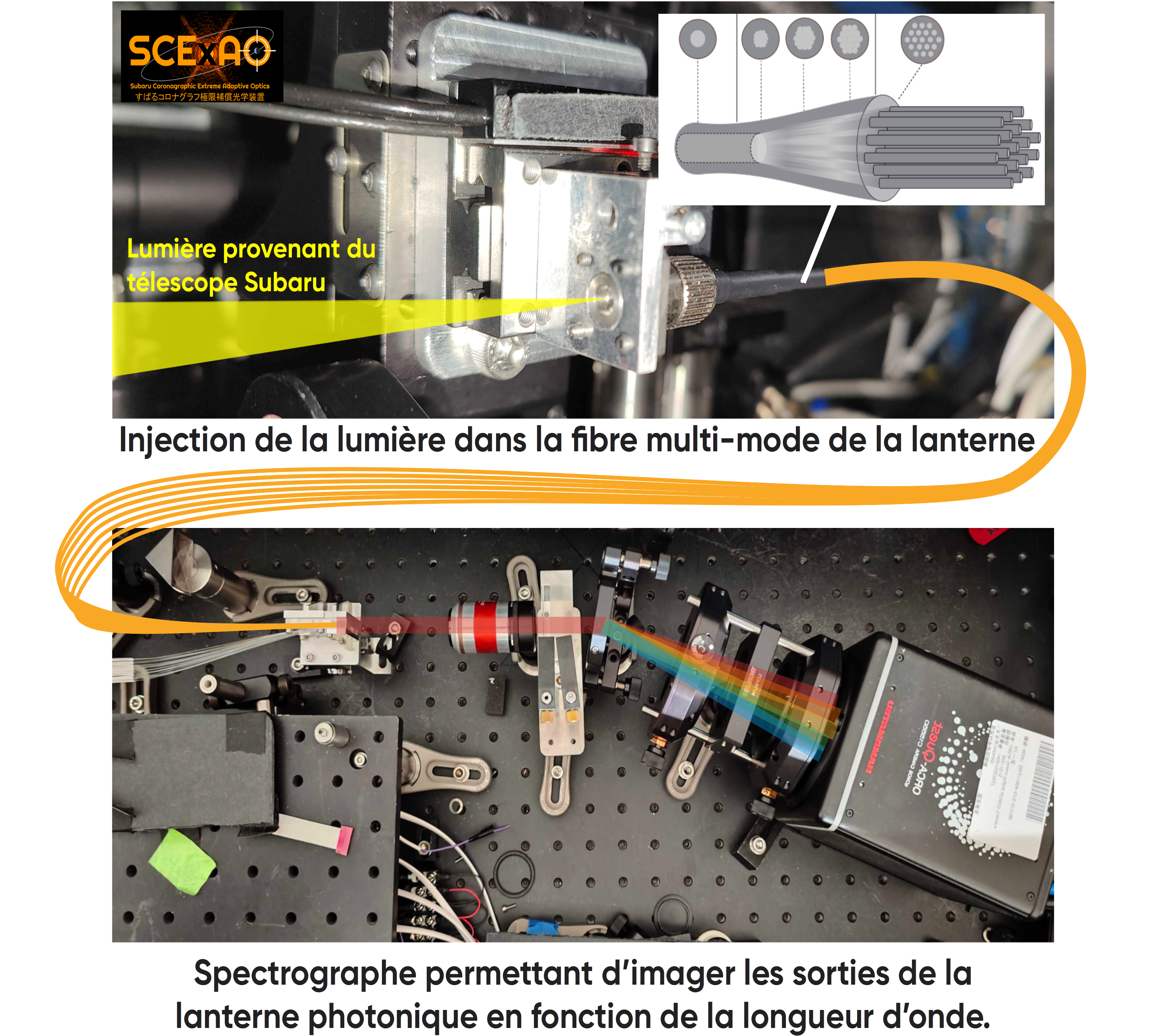
The latest major development of the instrument, known as FIRST-PL, is based on the use of a photonic lantern. This special optical fibre breaks down light into its spatial modes, providing high angular resolution whilst significantly improving the instrument’s sensitivity. Thanks to this innovation, FIRST-PL has achieved unprecedented precision in measuring very small spatial displacements as a function of wavelength (spectrometric astrometry), opening up new prospects for the study of forming exoplanets.
FIRST thus illustrates a gradual transformation in astronomical instrumentation : over 25 years, the project has evolved from a theoretical concept into an innovative photonic instrument. It is part of an ongoing process of research and innovation, at the interface between fundamental optics, technological developments and astrophysical ambitions. As such, FIRST demonstrates how instrumentation can push the boundaries of observation and open new windows onto the Universe.
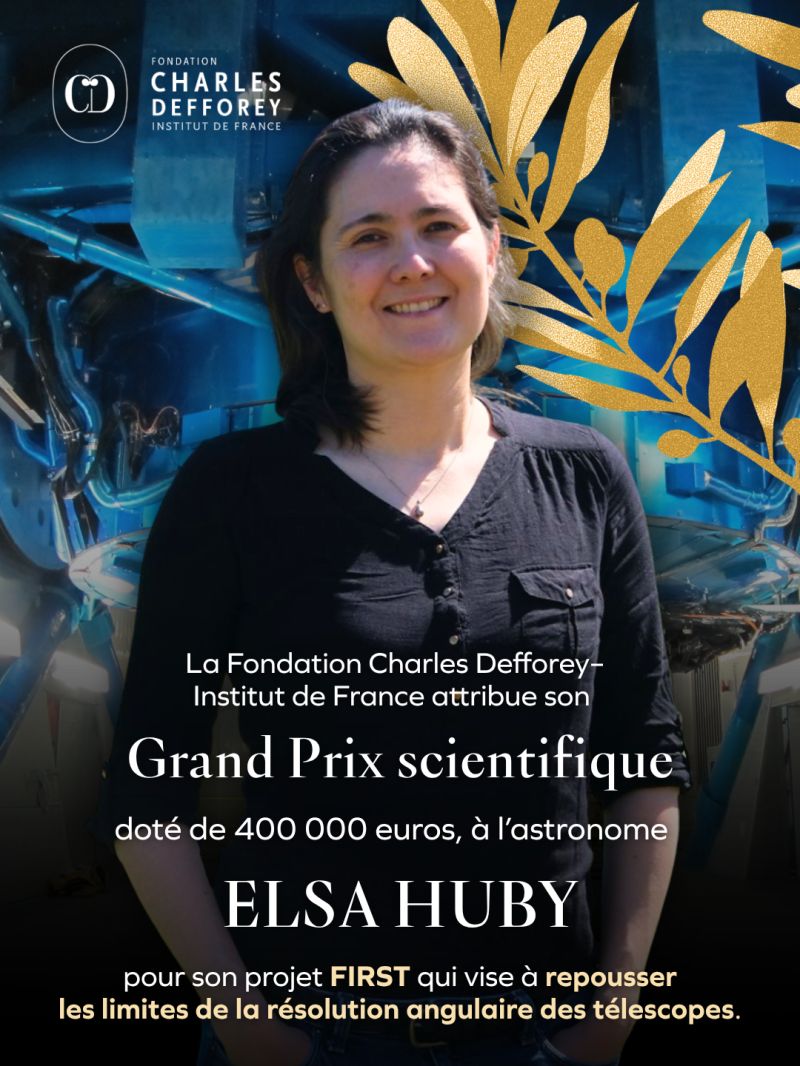
Elsa Huby, an astronomer at the Paris Observatory – PSL and a specialist in high-angular-resolution and high-contrast instrumentation.
Elsa Huby’s research lies at the intersection of physics, optics and astronomical observation, with the aim of detecting and characterising planets orbiting other stars in order to better understand how they form. A graduate of the Institut d’Optique, she completed her PhD on the FIRST project, which employs an interferometric technique based on optical fibres for high-resolution imaging. She then continued her work as a postdoctoral researcher at the University of Liège, specialising in coronography and high-contrast methods. In 2017, she joined the Paris Observatory – PSL as an assistant astronomer, where she took charge of the FIRST project. Her work contributes to the development of new approaches in astrophotonics, particularly for beam recombination using integrated optics or via the use of a photonic lantern. Supported by ANR Young Researcher funding (2021–2025), this project has opened up new avenues for the study of forming exoplanets. Her research contributes to the development of next-generation instruments for very large telescopes and future missions dedicated to the detection and characterisation.