Searching for protoplanets at the heart of the AB Aurigae disc
Although thousands of exoplanets are now known, their formation remains difficult to observe, as young planets emit little light and remain hidden within their surroundings. They are thought to form during the first few million years of a planetary system’s life, within vast protoplanetary discs composed of gas and dust. AB Aurigae is a very young star surrounded by such a disc, in which there are numerous indications that a process of planetary formation is underway. Thanks to its brightness and the extent of its disc, AB Aurigae provides an ideal laboratory for studying the conditions under which planets begin to form around intermediate-mass stars.
In 2017, ALMA (Atacama Large Millimetre/submillimetre Array) observed AB Aurigae in the submillimetre wavelength range in order to map the large dust particles and cold gas in the disc. The observations revealed two vast spiral arms of gas less than 100 astronomical units from the star, as well as a cavity at the centre of the disc. Models suggest that these spiral arms could be caused by an invisible companion located between 60 and 80 AU, whose gravitational influence disturbs the gas and produces waves comparable to a boat’s wake. They also suggest that the large cavity observed at the centre of the disc could be explained by a second companion located at around 30 AU, which is approximately the distance from Neptune to the Sun.
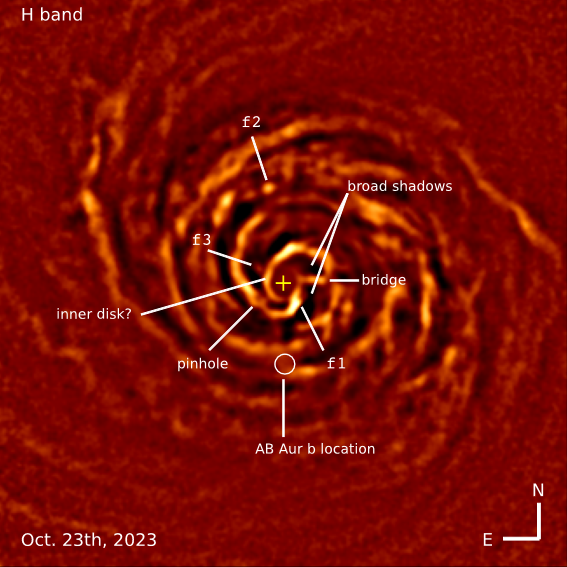
In 2019 and 2020, an international team led by LIRA observed these spirals using the SPHERE instrument on the Very Large Telescope (ESO), a project in which the laboratory is heavily involved. By imaging, in the near-infrared, the starlight scattered by dust, SPHERE confirms the existence of the two spiral arms and, crucially, reveals a twist at their junction, at the position corresponding to the f1 structure (see Figure 1). This structure, which connects an inward-pointing spiral arm to an outward-pointing one, is consistent with models of planetary formation and provides further strong evidence for the existence of a protoplanet. However, the protoplanet remains invisible and its mass is still difficult to determine.
In 2021, an American team used the Hubble Space Telescope and the Subaru Telescope (Hawaii) to observe the disc in the visible spectrum and to image the hydrogen (Hα) emission line, characteristic of the very hot gas surrounding a forming planet. The observations revealed a bright spot consistent with a Jupiter-like protoplanet located approximately 93 astronomical units from the star. Named AB Aur b, this source is difficult to detect in the SPHERE images (see Figure 1). However, this interpretation is disputed by other teams, who believe that this signal may simply be a reflection of stellar emission.
Finally, astrometric data from the Gaia satellite could also suggest the presence of a stellar companion rather than a protoplanet. However, this hypothesis remains highly uncertain, as the measurements are significantly disrupted by the gas- and dust-rich environment that still surrounds this young star, some of whose material is accreting onto its surface, creating areas of overbrightness.
The net is closing in on the protoplanet trail
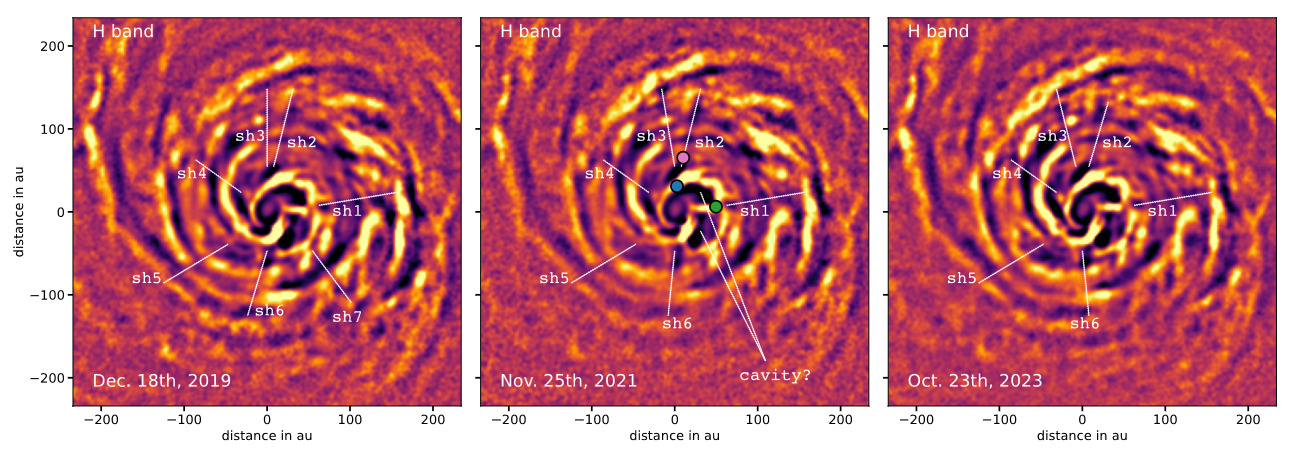
To gain a better understanding of the origin of these structures, the international team led by LIRA is continuing to image AB Aurigae using the SPHERE instrument on the Very Large Telescope. These new observations complement the previous ones, bringing the total number of observations carried out between 2019 and 2023 to three. This consistent series of observations makes it possible, for the first time, to track the rotation of a protoplanetary disc over nearly four years and to observe the evolution of its various structures with unprecedented precision (see Figure 2). This long-term monitoring has revealed several new findings.
Firstly, the scientists studied the disc’s rotation around the star and found that the inner region does not rotate as predicted by current models. The authors suggest that this behaviour could be explained by the interaction of several protoplanets orbiting in elliptical paths inclined relative to the disc’s plane.
The second finding concerns the three bright, compact structures (f1, f2 and f3), which are candidates for protoplanets (see Figure 1). The study shows that their orbits are inclined by several tens of degrees relative to the plane of the disc, a behaviour consistent with forming objects. However, the observations do not yet allow us to determine whether these are genuine protoplanets or simply concentrations of gas and dust. As for the candidate AB Aur b, the observation in the Hα line does not confirm the expected emission, calling its initial interpretation into question.
Finally, the images revealed seven faint radial shadows sweeping rapidly across the surface of the disc (see Figures 2 and 3). Like the shadows cast by clouds at sunset, they indicate the presence of opaque structures that are too small to be imaged directly. By tracking their movement from one observation to the next, it is, however, possible to estimate their position, with some being consistent with structures such as f1 (see Figure 3). These shadows could be produced by protoplanets, but also by opaque dust clumps ; it is not yet possible to determine which is the case.
The quest continues
Taken together, the results from this latest study paint a more complex picture than previously envisaged : rather than a single planet shaping the disc, several objects in the process of formation may be interacting simultaneously with the gas and dust.
The search for protoplanets around AB Aurigae continues. To take this research further, the scientific team has already secured two nights of observation on each of the two largest optical telescopes in the northern hemisphere : the Keck Telescope and the Subaru Telescope, both located in Hawaii. These new observations, carried out in the near-infrared with Keck (L-band) and in the visible and near-infrared with Subaru, should help to better test the various hypotheses and, perhaps, finally shed light on the mysterious structures surrounding AB Aurigae.
