The mission MMX
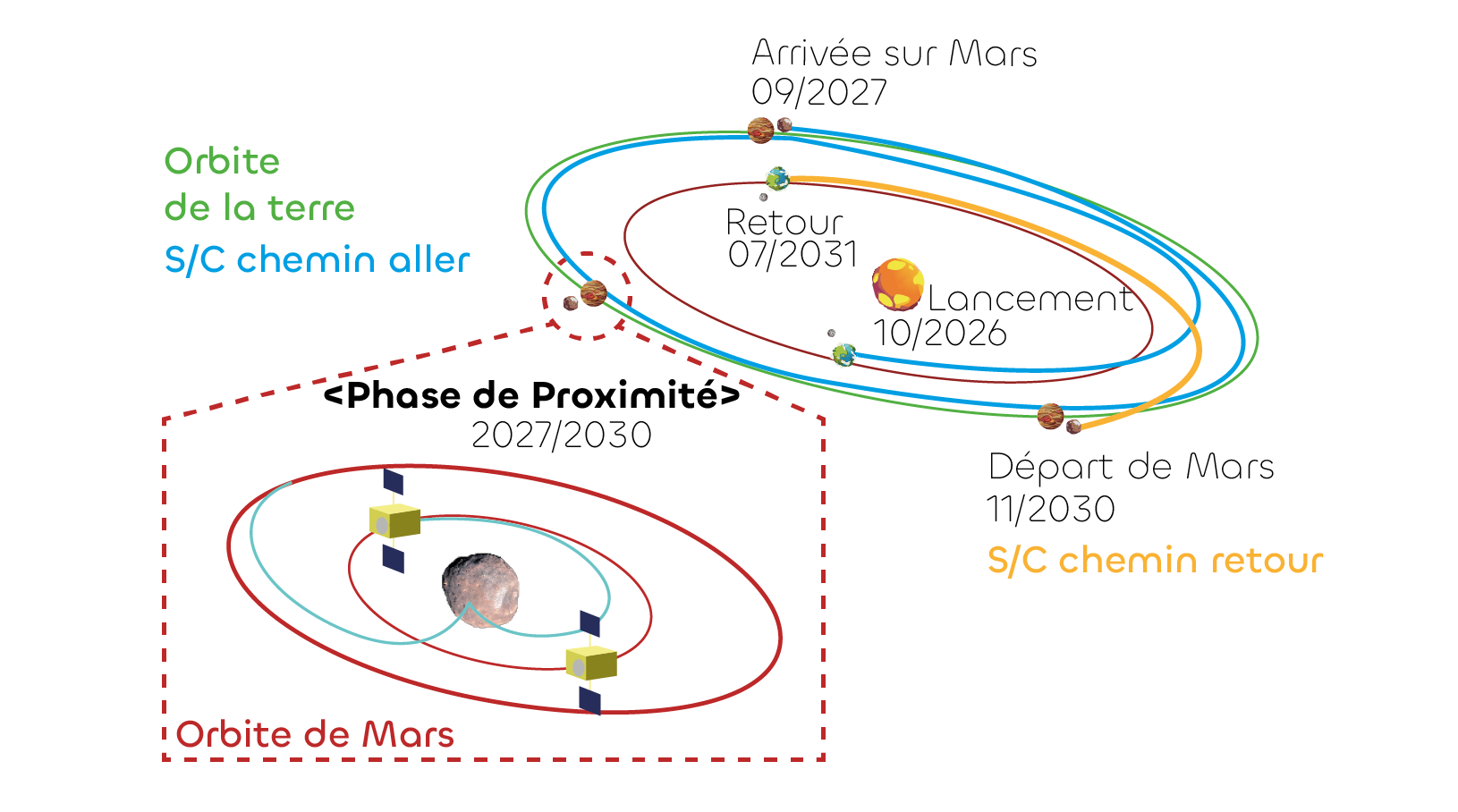
The satellite MMX The MMX satellite will launch in October 2026 toward the Martian system to return samples from the surface of Phobos, conduct detailed observations of Phobos and Deimos, and monitor the Martian climate. The mission will complete a five-year round trip, with the Phobos samples returning to Earth in July 2031. The spacecraft will arrive in the Martian system in August 2027. It will spend three years in near-satellite orbits (QSOs) around Phobos at different altitudes to select sampling and landing sites.
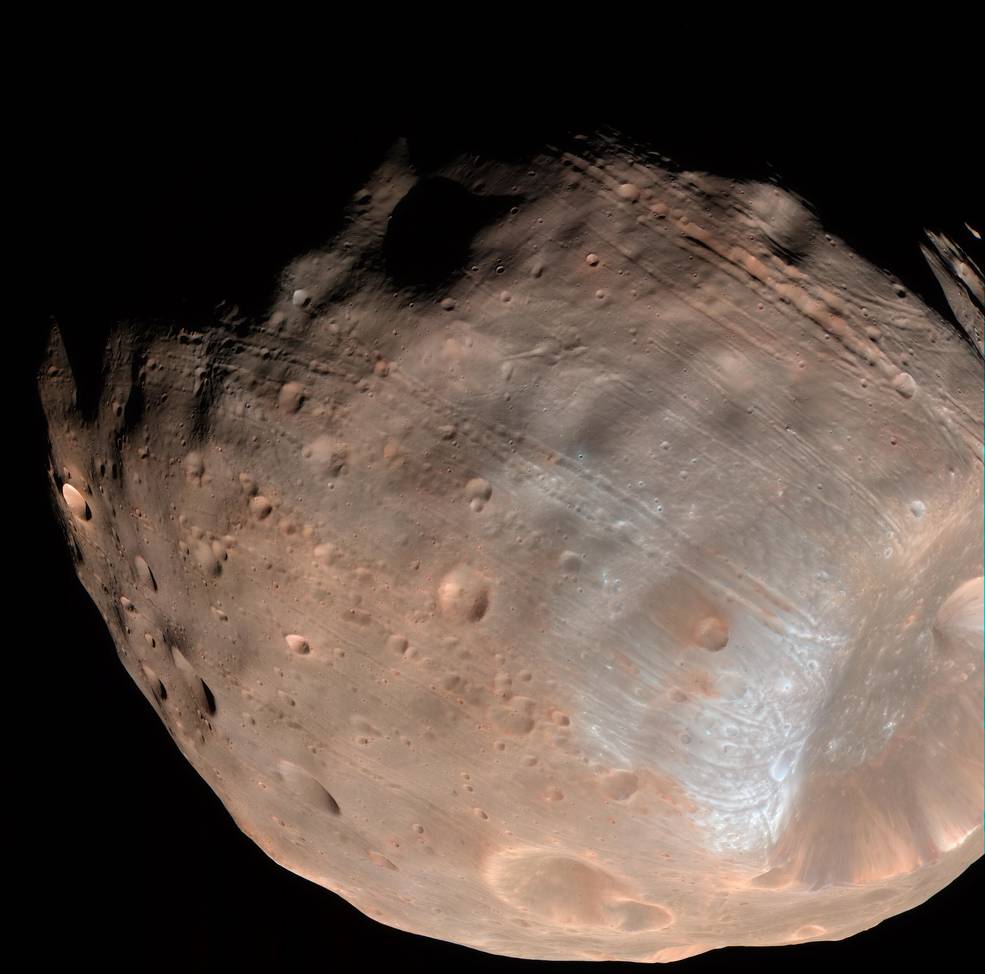
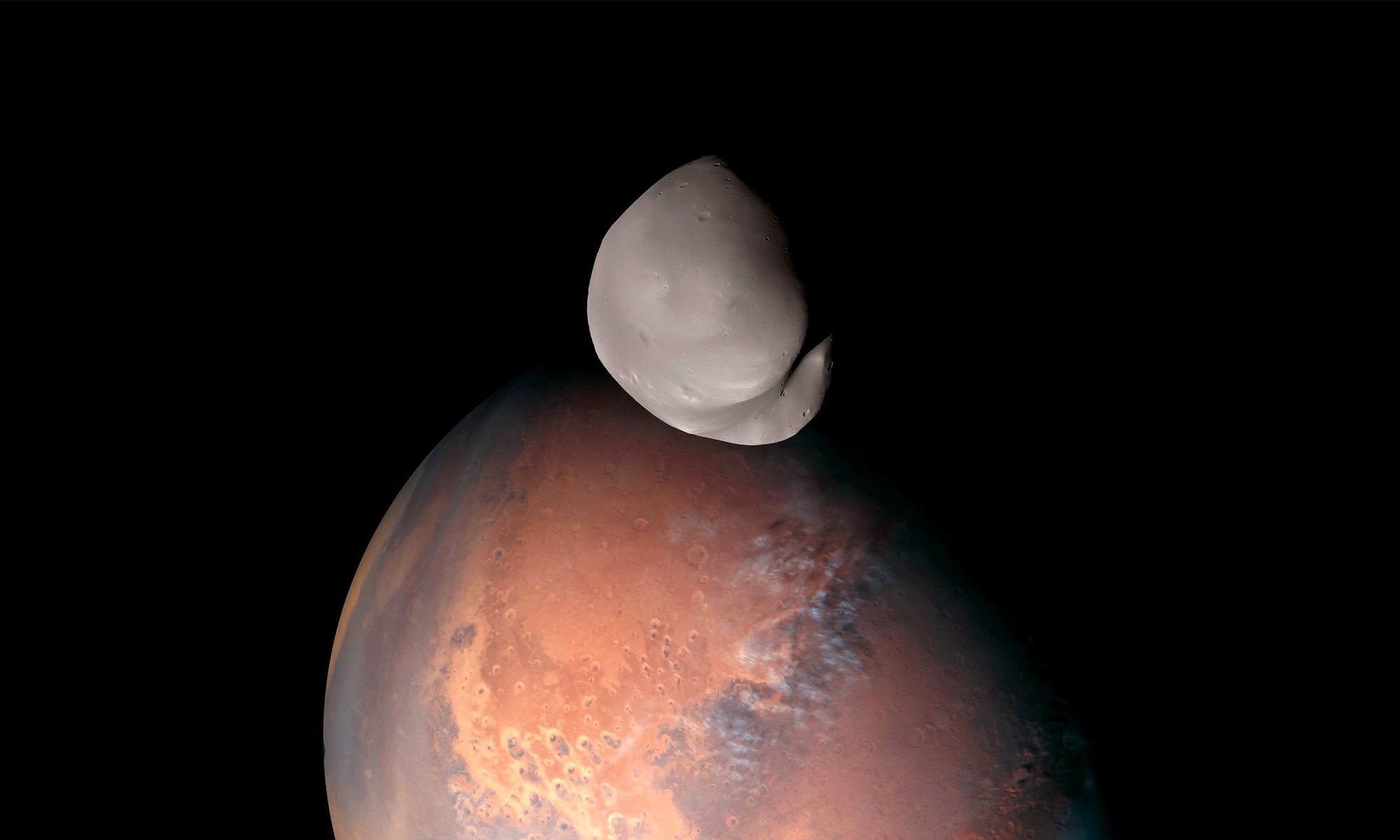
The probe will descend for several hours onto the surface of Phobos to collect at least 10 grams of Phobos regolith using two mechanisms : one on its feet and a core sampler drilled to a depth of 2 centimeters. MMX will collect samples from Phobos at two different sites.
After collecting the samples, the probe will leave the Martian system and return them to Earth, completing the first round trip to the Martian system.
The mission’s main objectives are :
- To understand the origin of Martian moons through close-up observations and sample return ;
- To constrain the processes of planetary formation and material transport in the region connecting the inner and outer solar system ;
- To reveal the evolutionary processes of the Martian system in circum-Martian environments.
The payload includes the following scientific instruments :
- MIRS (MMX Infrared Spectrometer)
- OROCHI (Optical Radiometer composed of Chromatic Imagers)
- TENGOO (Telescopic Nadir for Geomorphology)
- LIDAR (Light Detection and Ranging)
- MEGANE (Mars-moon Exploration with Gamma rays and Neutrons)
- CMDM (Circum-Martian Dust Monitor)
- MSA (Mass Spectrum Analyzer)
- C-SMP (Coring sampler)
- P-SMP (Pneumatic sampler)
- ROVER-IDEFIX (Moving vehicle)
- SRC (Sample return capsule)
- SHV (Super Hi Vision Cameras)
- IREM (Interplanetary Radiation Environments Monitor)
The small IDEFIX rover (total weight less than 30 kg), developed by CNES and DLR, will be deployed on the surface of Phobos. The rover’s payload includes four scientific instruments :
- a thermal infrared radiometer (miniRAD),
- a Raman spectrometer (RAX),
- a pair of forward-facing stereo cameras (NavCAM),
- two cameras that observe the wheel-surface interface (WheelCAM) to study the mechanical properties of Phobos’ regolith.
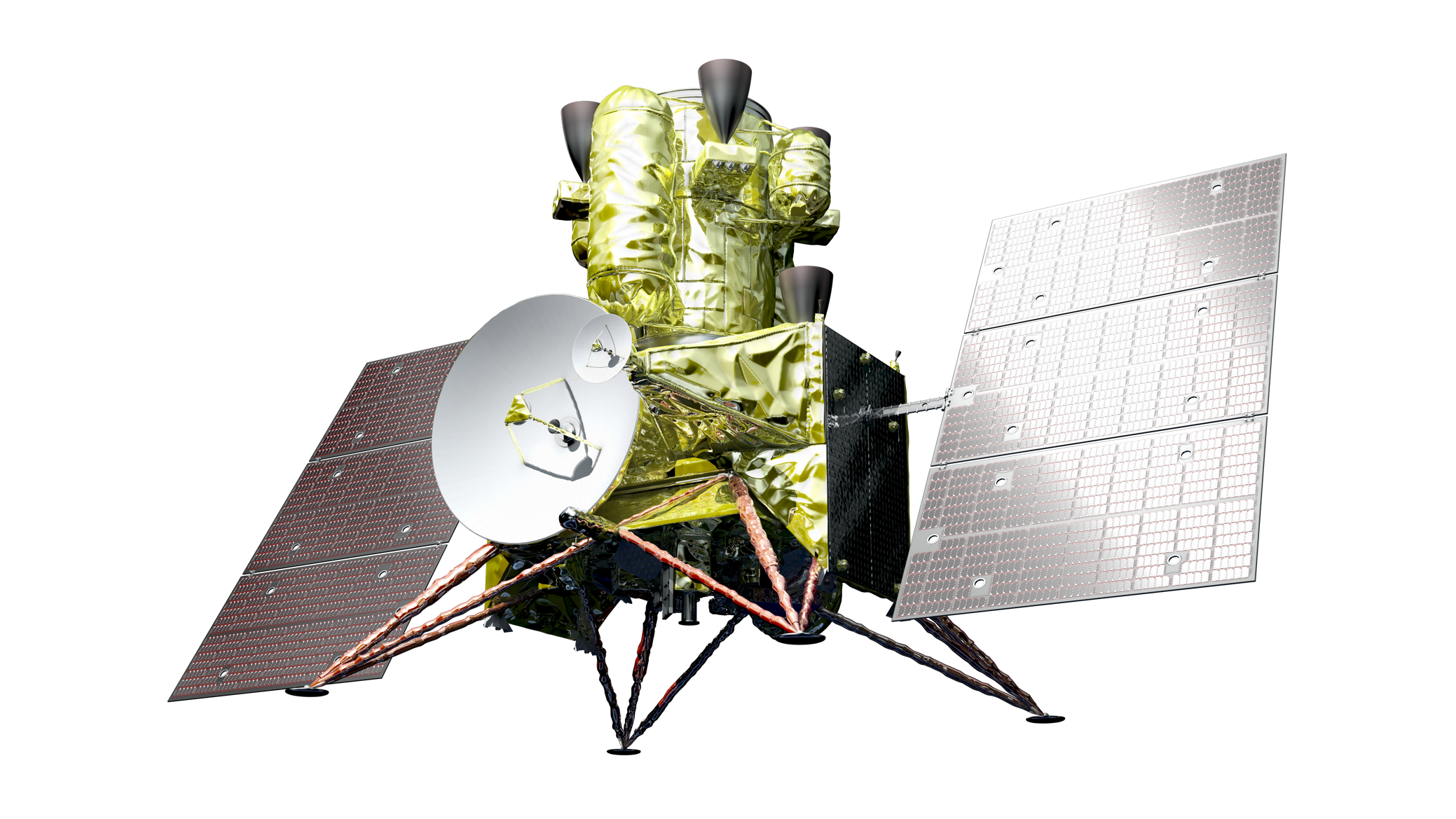
ESA will participate in the mission, contributing to communications with the antennas of its deep space network.
MIRS
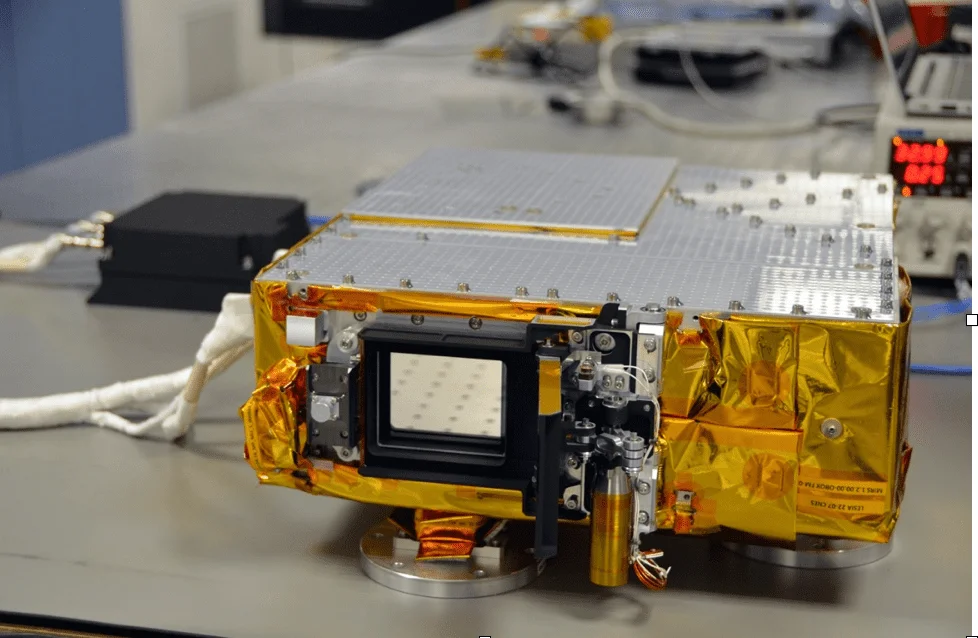
MIRS This is an imaging spectrometer in the 0.9–3.6 micron spectral band with a spectral resolution better than 20 nm. The IFOV (field of view of one pixel) is 0.35 milliradians, and the total field of view is +/- 1.65 degrees. The signal-to-noise ratio is greater than 100 down to 3.2 µm with an integration time of less than 2 seconds. The detector has dimensions of 256 x 250 pixels with a pixel size of 30 microns. The total mass is 10.2 kg. The instrument volume is approximately 165 x 155 x 65 mm3 for the electronic EBOX, et 320 x 150 x 505 mm3 for the optical OBOX unit.
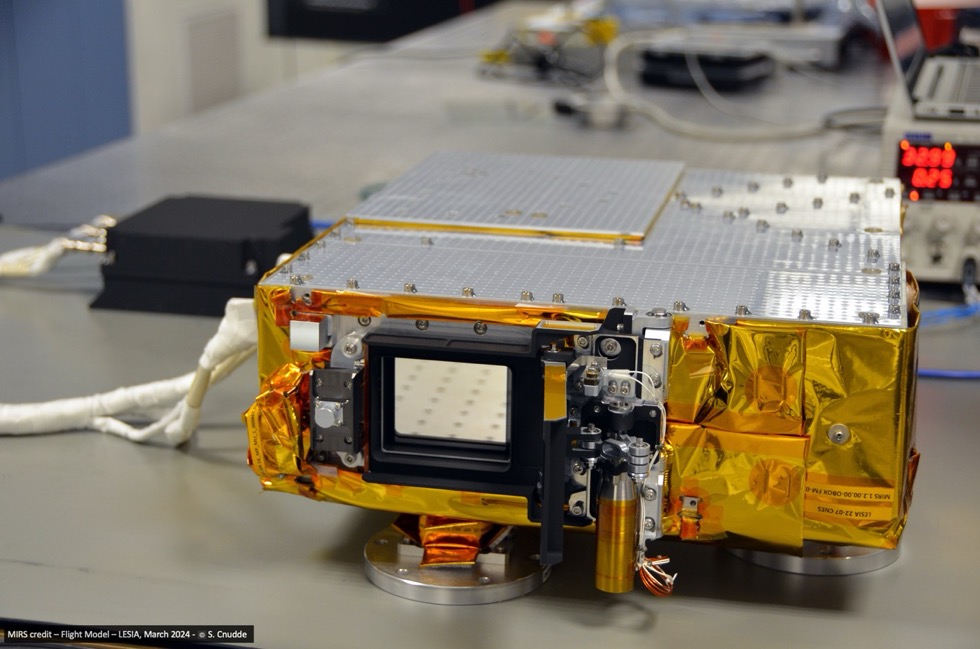
The MIRS instrument is the prime contractor for LESIA (now LIRA) in collaboration with five other French laboratories and CNES : the Bordeaux Astrophysics Laboratory (LAB), the Laboratory for Atmospheres, Environments, and Space Observations (LATMOS), the Midi-Pyrénées Observatory (OMP), the Marseille Astrophysics Laboratory (LAM), and the Institute for Research in Astrophysics and Planetology (IRAP). CNES is the project owner for the MIRS instrument.
The flight model of the MIRS instrument was delivered to JAXA at the end of March 2024, and then integrated in two stages onto the MMX satellite’s Exploration Module : in July 2024 for EBOX, and then in September 2024 for OBOX. The ground test campaign is currently underway at MELCO (Kamakura, Jp) before transport to the launch site at Tanegashima (Japan), for a launch planned with the H3 launcher in October 2026.
The science objectives of MIRS
MIRS will characterize the surfaces of Phobos and Deimos and the atmospheric composition of Mars by identifying characteristic spectral signatures in the near-infrared. MIRS must meet the mission requirements, in particular :
1) Study the surface distribution of the constituent materials of Phobos. Hydrated and other minerals must be identified in relation to the topography and characterized spectroscopically at a ground resolution of 20 m over almost the entire surface of the moon, and at a spatial resolution of 1 m within a 50 m radius of the sampling point. MIRS will measure the water (ice) content (absorption band at 3.0–3.2 μm), hydrated silicate minerals (characteristic absorption bands at 2.7–2.8 μm), and organic matter (3.3–3.5 μm) across the entire surface.
2) Study the distribution of the constituent materials of Deimos, using spectroscopic data ; determine, in relation to the topography of characteristic areas of the lunar surface, the distribution of hydrated minerals and other minerals, with a horizontal spatial resolution of 100 m or better.
3) Constrain the transport processes of dust and water near the Martian surface : continuous observations of dust storms, ice clouds, and water vapor will be conducted for mid- and low-latitudes from the high-altitude equatorial orbit during different seasons with a temporal resolution of 1 hour.
MIRS observations will determine the distribution of water vapor in atmospheric columns with a spatial resolution of 10 km, an absolute spectral radiometric accuracy of 10%, a relative spectral radiometric accuracy of 1%, and a temporal resolution of less than 1 hour in selected low-latitude areas. These observations will be conducted over several consecutive days in different seasons.
MIRS will allow scientists to study the composition of Phobos and Deimos and to characterize temporal variations in the Martian atmosphere. It will also be a key instrument in helping to select the two sample collection sites on the surface of Phobos.
For further readings
- Web site of project MIRS : https://sites.lesia.obspm.fr/mirs-public/
- Movie presentation of MIRS and the MMX mission : https://www.youtube.com/watch?v=ibFYY9D4gm8
- Web site of MIRS (CNES) : https://cnes.fr/projets/mmx
LIRA staff involved in the project
- Antonella BARUCCI (PI)
- Pernelle BERNARDI (Instrument System Manager and 2025 Project Manager)
- Marion BONAFOUS (AIT)
- Tristan BUEY (Detector Expert)
- Frédéric CHAPRON (Mechanical Architect)
- Alain DORESSOUNDIRAM (Deputy PI)
- Sonia FORNASIER (Instrument Scientist)
- Marcello FULCHIGNONI (Associated Scientist)
- Sophie JACQUINOD (Data Pipeline Manager)
- Vincent LAMANDE (Mechanical Analysis Contract)
- Cédric LEYRAT (Co-I)
- Christophe MATHÉ (Data Pipeline)
- Frédéric MERLIN (Co-I)
- Napoléon NGUYEN-TUONG (Thermal Architect)
- Patricia NIBERT (Administration)
- Jérôme PARISOT (AIT Manager)
- Giovanni POGGIALI (Postdoctoral Researcher)
- Jean-Michel REESS (Project Manager 2020-2024, Deputy Project Manager)
- Robin SULTANA (Postdoctoral Researcher)
- Tanguy BERTRAND (Associated Scientist)
- Koki YUMOTO (Postdoctoral Researcher)
- Antonin WARGNIER (PhD Student)
- Didier ZÉGANADIN (AP/AQ)
The following also contributed to the development :
- Vartan ARSLANYAN (Mechanical Manufacturing)
- Eve BAGOLIN (Electronics AIT)
- Bruno BORGO (Mechanical Design)
- Aurélien BOUR (Optical Design)
- Léa DARTIGUES (AQI)
- Gaël DAVID (Postdoctoral Researcher)
- Julie DEVILLE (AQI)
- Corentin GABIER (Fixed-Term Contract - Thermal Analysis)
- Leandro GASPARINI (AIT - Instrument Operator)
- Karim HUSSEIN (AIT Optics)
- Dieudonné KITEZE (Fixed-term contract in mechanical analysis)
- Ludovic LE NOC (Fixed-term contract in mechanical design)
- Sophia MARZOUQ (AIT)
- Odile MBEUMOU (AP-AQ)
- Didier PERION (Deputy AIT Manager)
- Arthur STIBBE (AIT Mechanics)