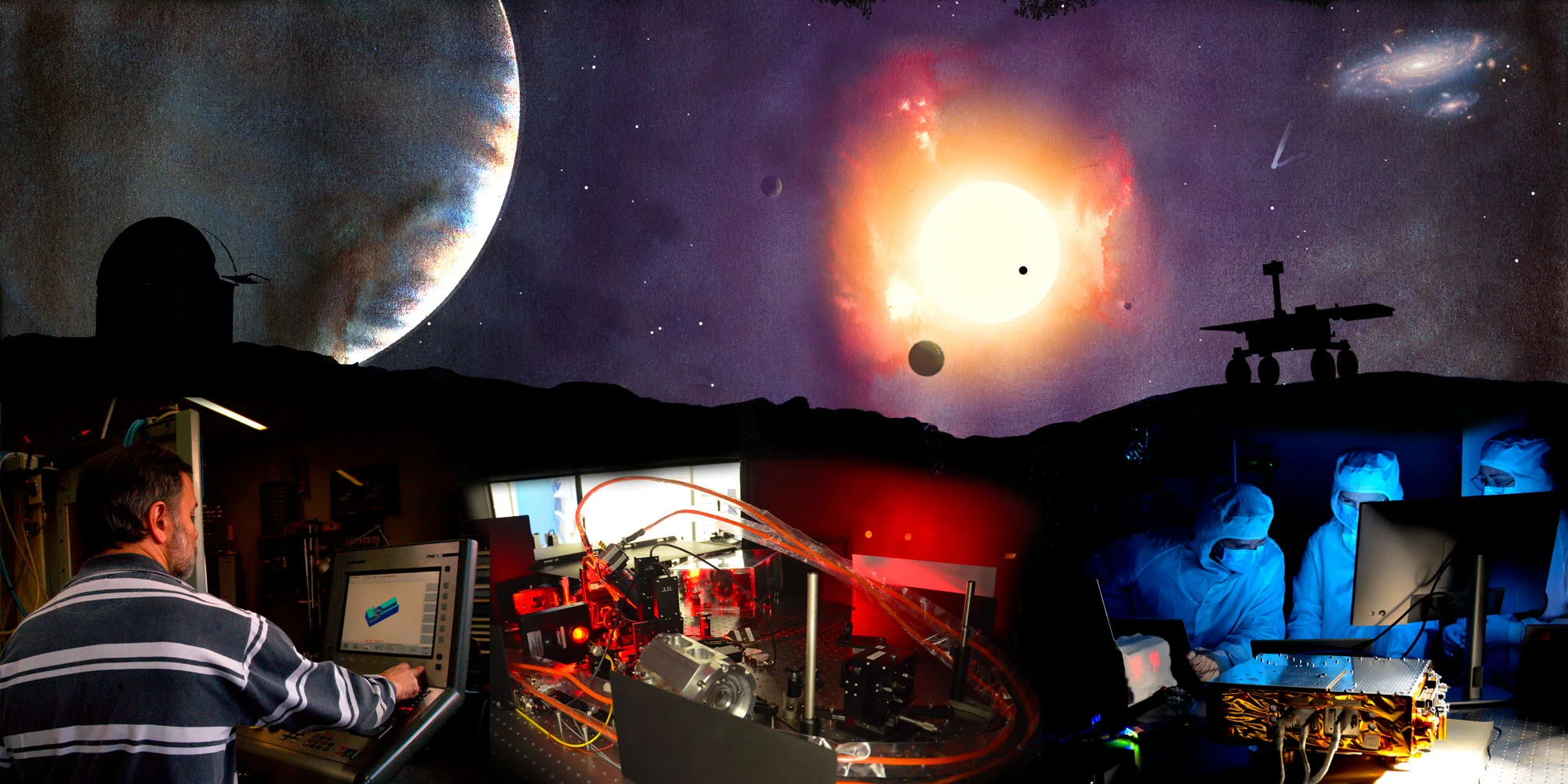

Thesis title
3D radiative analysis of multi-waveband IR-emission in the archetypal Seyfert 2 AGN NGC1068 using GRAVITY and MATISSE VLTI observations.
Composition of the jury
- Chair of the Jury/Examiner : Paola Di Matteo (LIRA)
- rapporteurs : Almudena Prieto (IAC, Espagne) & Almudena Alonso-Herroro (CAB, Espagne)
- Examinater : Ilse de Looze (Ugent, Belgique)
- Thesis supervisors : Yann Clénet (LIRA), Romain Petrov (OCA, Lagrange)
Abstract
This thesis investigates the structure of the dusty environment in active galactic nuclei (AGN), focusing on the archetypal type 2 NGC 1068, by combining infrared interferometry and 3D radiative transfer modelling. The Very Large Telescope Interferometer (VLTI) has produced spatially resolved images of circumnuclear dust on parsec and sub-parsec scales, directly probing the structure invoked by AGN unification models and the interface between SMBH feeding and feedback. The concept of a static torus has been evolved to a more complex morphology including a clumpy equatorial distribution and a radiation-driven polar dusty wind, a scenario partially triggered by VLTI/MIDI results. Recent VLTI/GRAVITY K-band data for AGN NGC 1068 reveal an inclined, ring-like sublimation rim at the hottest dust radius, while MATISSE mid-IR multi-band observations, when combined with GRAVITY, favor an edge-on equatorial structure with a polar extension. These results highlighted the necessity of a multi-band and three-dimensional interpretation, to break this degeneracy. A parametric geometric model was developed consisting of a clumpy equatorial torus and a dusty polar wind (disk+wind) populated by spherical clouds emitting as blackbodies. The model reproduces K-N band interferometric observables and provides a self-consistent 3D framework that resolves inter-instrument registration. This disk+wind model was extended to and modeled for larger scales with LBTI data, which reveals an morphological link between the dusty wind and a shock-heated bubble, produced by the AGN outflow (primarily the radio jet) and with dense, clumpy circumnuclear material. These larger-scale observations also confirm the existence
of an over-resolved emission component not recovered by VLTI. This study presents the first spatially resolved investigation of the dust distribution in the target AGN using 3D radiative-transfer modelling. The framework permits exploration of varying dust compositions and the impact of AGN. Radiative transfer results reveal broken
temperature power laws, attributable to differential grain sublimation at distinct radii. Overall, the modelling supports the global geometric picture—including an over-resolved component, but shows that no single AGN model reproduces all observables across K-N. Shorter wavelengths (K–M bands) demand a relatively stronger contribution from the dusty polar wind and hot inner dust, while the N band is dominated by cooler, more extended structures. These findings indicate that different spectral bands probe distinct physical regimes that the single simple geometry cannot fully capture. Future work should focus on combining multi-scale observations, improving constraints on dust properties and temperature structures, and extending the model to include larger-scale dust components and their impact on radiative transfer.
