Exploring with MIRS : a key role for Paris Observatory – PSL

Where did Phobos and Deimos come from ? Are these two small moons asteroids captured by Mars, or did they form from debris ejected during a giant impact on the planet ? This is one of the major questions that MMX, short for Martian Moons eXploration, aims to answer. The mission is led by the Japan Aerospace Exploration Agency (JAXA), working with several international partners, including France.
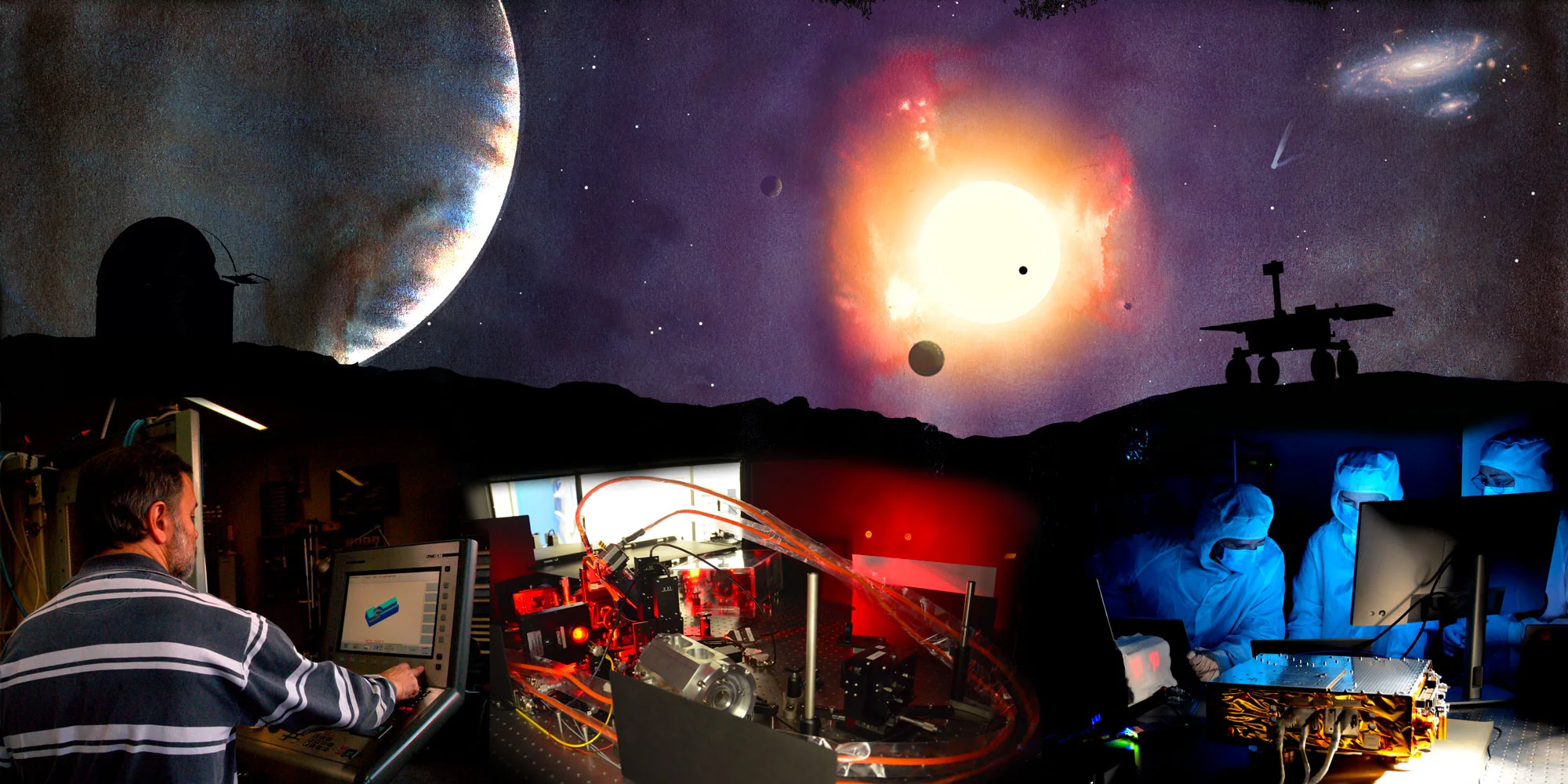
To investigate, MMX carries MIRS, a near-infrared imaging spectrometer designed in France, with LIRA leading its development under CNES oversight. By splitting the light reflected by Phobos and Deimos into its constituent wavelengths, the instrument will map their mineral composition and search for signatures of hydrated minerals and organic matter. It will also contribute to studies of the Martian atmosphere and the selection of sampling sites on Phobos.
Paris Observatory – PSL also contributes to the mission’s navigation. Working with CNES and JAXA, the Laboratoire Temps Espace (LTE) helped improve the ephemerides of the Martian moons, which provide precise predictions of their positions over time. This information is essential for approaching and landing on Phobos.
A fleeting but unforgettable moment

From the initial idea to installation aboard a rocket, a space mission takes many years to develop, sometimes several decades. For the teams who design, assemble and test its instruments, attending the launch brings the joy of seeing that sustained effort come to fruition. In just a few minutes, the result of their collective work leaves Earth. The emotion of departure mingles with relief as this first decisive milestone is reached. It is also a chance for one last farewell, a final word of encouragement to the instrument before its great journey, in the hope that it will fulfil its promise.
“What an emotional moment, and what a relief to see MMX lift off on 20 October in Japan !” says Pernelle Bernardi, instrument systems engineer and project manager at LIRA. “The MMX-MIRS adventure began unexpectedly in March 2020 at LESIA, but the team rose to the challenge, developing the instrument in a record four years and delivering it to JAXA in April 2024. This was followed by two and a half years of involvement in spacecraft testing, first at MELCO in Kamakura, then at the launch site in Tanegashima.”
Sonia Fornasier, MIRS Deputy Principal Investigator, shares that emotion :
“It was deeply moving, and a source of immense pride, to see the mission lift off and light up the sky, with Mars shining nearby, as we gathered with our colleagues from this major international collaboration.”
Alain Doressoundiram, MIRS Co-Investigator, also witnessed the departure :
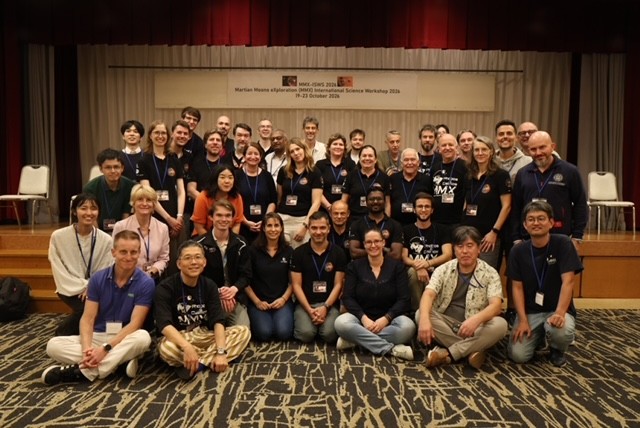
“What an unforgettable night here in Japan ! At 4:41 a.m., JAXA’s H3 rocket, carrying the MMX (Martian Moons eXploration) spacecraft, lifted off from Tanegashima, lighting up the beautiful starry sky. Watching this spectacular launch from Yakushima, surrounded by so many colleagues from the international MMX team, was a truly moving experience !”
Beyond the spectacle, attention is already turning to the observations ahead.
“This marks the beginning of a unique scientific exploration of the Martian system, and we eagerly await the first data from MMX and MIRS !” adds Sonia Fornasier.
The excitement is only beginning…
Following a nominal launch, MMX separated from the rocket’s second stage 71 minutes and 13 seconds after liftoff, on its planned trajectory towards Mars. Initial operations then proceeded successfully : both solar arrays were deployed, the spacecraft’s attitude was stabilised, and the medium-gain antenna was released. Communications were established with JAXA’s ground stations and NASA’s Deep Space Network.
At LIRA, the team is monitoring the spacecraft’s engineering telemetry to assess the condition of MIRS. The first readings are reassuring : after cooling rapidly following launch, the electronics and optical units remain within their allowable in-flight temperature ranges.
“In short, so far, so good !” says Pernelle Bernardi.
The next milestone is scheduled for 7 November, when MIRS will be powered on for the first time and its components tested with the dust cover closed. On 10 November, a warm-up sequence will prepare the cover for opening, followed by another functional test.
“A new chapter is opening, with testing during cruise and insertion into Mars orbit in September 2027. GO MIRS !” concludes Pernelle Bernardi.