At its meeting on June 10 and 11, 2026, at the Instituto Astrofísico de Canarias in Tenerife, the ESA Science Program Committee recommended the selection of Plasma Observatory as the agency’s next medium-class (M7) mission under its science program.
Plasma Observatory was among three finalists—along with THESEUS and M-MATISSE—selected by ESA in 2023. It would thus be the first medium-class mission to join Voyage 2050, ESA’s future science program, with a launch scheduled for the mid-2030s.
An ambitious mission to understand the physics of natural plasmas
Plasma Observatory will be an observatory dedicated, as its name suggests, to a state of matter that is very rare on Earth in its natural state but constitutes the bulk of observable matter in the Universe : plasma, which consists of charged particles. The physics of space plasmas thus lies at the intersection of fundamental physics and astrophysics, shining a spotlight on the direct study of physical phenomena observed in space through space probes.
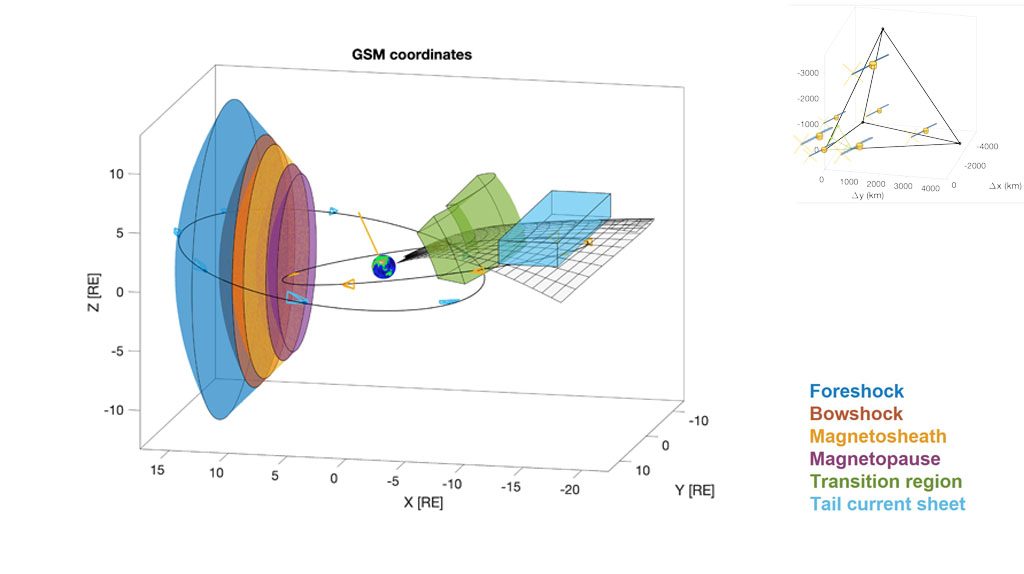
Plasma Observatory builds on the legacy of Cluster, a pioneering ESA mission consisting of four spacecraft, which has shaped research on space plasmas in Europe and around the world over the past 25 years, alongside multi-point missions such as Themis and MMS. With seven identical probes forming two interlocking tetrahedrons that will operate in a coordinated manner, Plasma Observatory will mark a new milestone in the exploration of Earth’s magnetosphere, the closest and most accessible natural plasma laboratory for observation.
This mission will simultaneously observe several characteristic scales, ranging from collective plasma motions to processes involving ions and, in certain regions, electrons.
Its objectives are to :
- understand how particles are accelerated and gain energy in the magnetosphere ;
- identify the physical mechanisms that transport energy and govern interactions between the different regions of Earth’s magnetosphere.
Plasma Observatory will thus make it possible, for the first time, to link the observed microscopic phenomena to the global dynamics of the magnetosphere, in order to better understand the fundamental mechanisms at work in the plasmas of the Universe.
Recognized Expertise from the Paris Observatory
Researchers and engineers at the Paris Observatory bring world-class expertise in the in situ measurement of space plasmas to this European mission.
Their contribution draws on a long tradition of instrumentation, which takes on a new dimension here : historically specialized in radio wave measurements and the study of electromagnetic fields (Solar Orbiter, BepiColombo, Parker Solar Probe), Laboratory for Instrumentation and Research in Astrophysics - LIRA’s contribution to the Plasma Observatory is based on the design of the flight software (derived from Plato) for the suite of instruments dedicated to particle measurements.
One of the LIRA team’s objectives is therefore to reconcile the measurements taken by three particle analyzers with local magnetic field measurements.
One of the sub-instruments is a 3DCAM camera, named iEPC and developed at the Plasma Physics Laboratory, which operates under the secondary supervision of the Observatory. LIRA is a partner in the development of a flight model of the 3DCAM camera that could fly aboard a low-Earth orbit spacecraft for validation as early as 2028, before being deployed on constellations dedicated to acquiring data for space weather monitoring.
Philippe Stee, President of the Paris Observatory – PSL, welcomes this major milestone : I am delighted to see the expertise of the Paris Observatory – PSL teams put to use in this new European space venture dedicated to a better understanding of our planet ; alongside our partners, we will continue our commitment toward the final approval of the mission, which is expected to yield numerous scientific benefits.
The official decision regarding the final approval of the Plasma Observatory mission by ESA is expected in November 2026.
