DragonFly : a dragonfly on Titan searching for potential clues to prebiotic chemistry
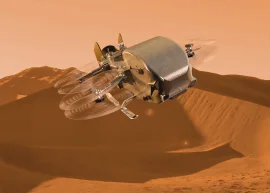
The Dragonfly mission is a NASA mission led by the Applied Physics Laboratory (APL) at Johns Hopkins University. Scheduled for launch in 2028 and arrival in 2034, its aim is to study the atmosphere and surface of Titan, Saturn’s largest moon.
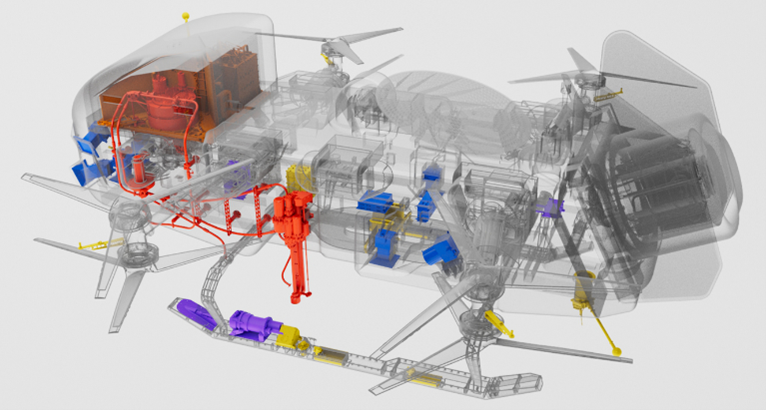
Following on from the European Huygens lander, which arrived over twenty years ago, Dragonfly is a rotorcraft capable of flying a few hundred metres above Titan’s surface. It will thus be able to explore different geological environments, hundreds of kilometres apart, in search of evidence of prebiotic chemistry – that is, chemical interactions between complex organic compounds that may have existed before the emergence of life as we know it on Earth.
During its mission, scheduled to last more than three years, Dragonfly will explore the region from the equatorial dunes to the Selk impact crater, which is around 70 km wide, where liquid water, mixed with organic matter, has likely persisted for hundreds, or even thousands, of years. At these exceptional sites, it will collect surface material samples to analyse their molecular composition using the DraMS (Dragonfly Mass Spectrometer and Gas Chromatograph) instrument. The samples will be vaporised and then analysed in detail using a gas chromatograph coupled with a mass spectrometer (see Figure 1). These analyses will enable the study of the evolution of the building blocks of prebiotic chemistry across the different types of terrain encountered (ranging from arid dunes to the Selk impact crater, which may have once contained liquid water).
The French contribution at the heart of Dragonfly’s instrumentation
France is involved in the Dragonfly mission through the development of DraMS-GC, the gas chromatography component of the DraMS instrument. Funded by CNES, this instrument is being developed under the leadership of LATMOS (Laboratory of Atmospheric Sciences and Space Observations), in collaboration with LIRA. More specifically, LIRA was responsible for the mechanical and thermal design of the instrument, the manufacture of the various models, including the flight models intended for Titan, as well as the conduct of the qualification campaigns.
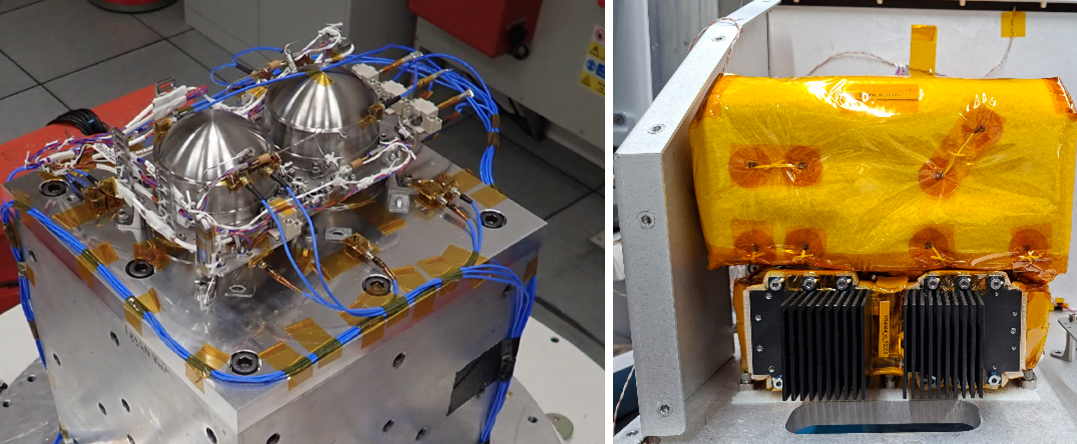
DraMS-GC consists of two subsystems. The first, called He Supply (see Figure 2.a), transports the vaporised samples in gaseous form using helium, which acts as a neutral carrier gas. These samples are then conveyed to the second subsystem, the Integrated-GC (see Figure 2.b), which is responsible for trapping and then separating the various constituents of the gaseous mixtures obtained after pyrolysis or treatment with a chemical agent. The latter facilitates, in particular, the detection of complex molecules, including chiral molecules, within the chromatography columns. The compounds thus separated can then be analysed by the mass spectrometer, the second part of the DraMS instrument, in order to determine their composition.
Validation in mechanical and thermal environments for DraMS-GC
In collaboration with teams from LATMOS and the Integration and Test Platform at the Versailles Saint-Quentin-en-Yvelines Observatory, and under the supervision of LIRA, the DraMS-GC flight models have just been successfully qualified in mechanical and thermal environments.
This qualification is based on a series of mechanical and thermal tests designed to replicate the conditions to which the instrument will be subjected during its mission. The mechanical tests are carried out using vibration test rigs (see Figure 2.a), in order to simulate the vibrations associated with rocket launch and the operation of Dragonfly. The thermal tests, meanwhile, are conducted in chambers capable of reproducing the pressure and temperature conditions prevailing on Titan, which the instrument will have to withstand during its exploration (see Figure 2.b).
Now that this key milestone has been reached, the next phase involves delivering DraMS-GC to NASA’s Goddard Space Flight Center (GSFC). The He Supply subsystem has already been shipped to the United States. As for the Integrated-GC, having just completed a bakeout phase (a degassing process lasting around ten days at +60 °C) at LIRA, following its scientific testing campaign at LATMOS, it will be delivered to GSFC in April for environmental functional testing.
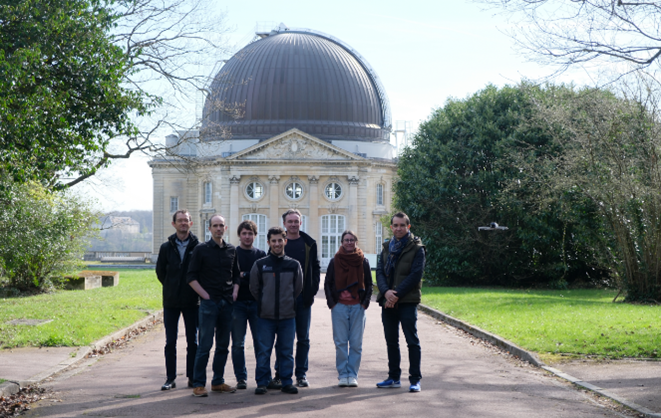
These developments crown six years of work by LIRA’s technical and engineering teams (see Figure 3), notably the GEFL (LIRA’s Research and Manufacturing Group), responsible for the design, manufacture and qualification of the instrument, SPIN (Project and Instrumentation Support), responsible for project support and quality activities, and MESPAL (Test Facilities, Clean Rooms, AIT/AIV), involved in bake-out operations as well as IT and administrative support. These are the result of a long and rigorous process, punctuated by numerous reviews validating the various stages of a space instrumentation project.
Contacts :
- Napoleon Nguyen Tuong, LIRA Technical Manager at DraMS-GC ;
- Sandrine Vinatier, LIRA Scientific Lead at DraMS-GC.