
Direct imaging of exoplanets: a real challenge
Exoplanets are prime targets for astronomical observation because they provide a better understanding of how planetary systems, including our own, are formed. In 30 years, 7,500 exoplanets have been discovered. This number is growing exponentially thanks to human genius, which is equipping itself with new, increasingly powerful telescopes and new observational techniques to overcome the difficulties.
There are several techniques for detecting exoplanets, one of which involves directly imaging a planet in orbit around its host star. You might think that this method is the simplest, because it seems the most intuitive. However, this is not the case! In reality, direct imaging of exoplanets is complex for two main reasons: it requires sufficient angular resolution to distinguish the planet from its star, and adequate sensitivity to obtain a contrast that brings out the pale glow of the planet compared with a star that shines millions of times more brightly. It is for these reasons that most exoplanet detections by direct imaging involve planets far from their star, at least ten times the Earth-Sun distance (10 AU), and very massive (around that of Jupiter) so that their infrared emission is more intense.
From an observational point of view, it is possible to overcome these difficulties and hope to image smaller planets closer to their stars by using several strategies:
- Increasing the diameter of the telescope, which improves angular resolution.
- Observing in the mid-infrared, which enhances the star-planet contrast. In this part of the electromagnetic spectrum, the planet is brighter because we can observe its thermal emission rather than its reflected light, while the star is less luminous.
- Use a coronagraph to mask the star’s light, making it easier to observe surrounding objects drowned out by its brilliance.
- Observe from space to avoid atmospheric turbulence.
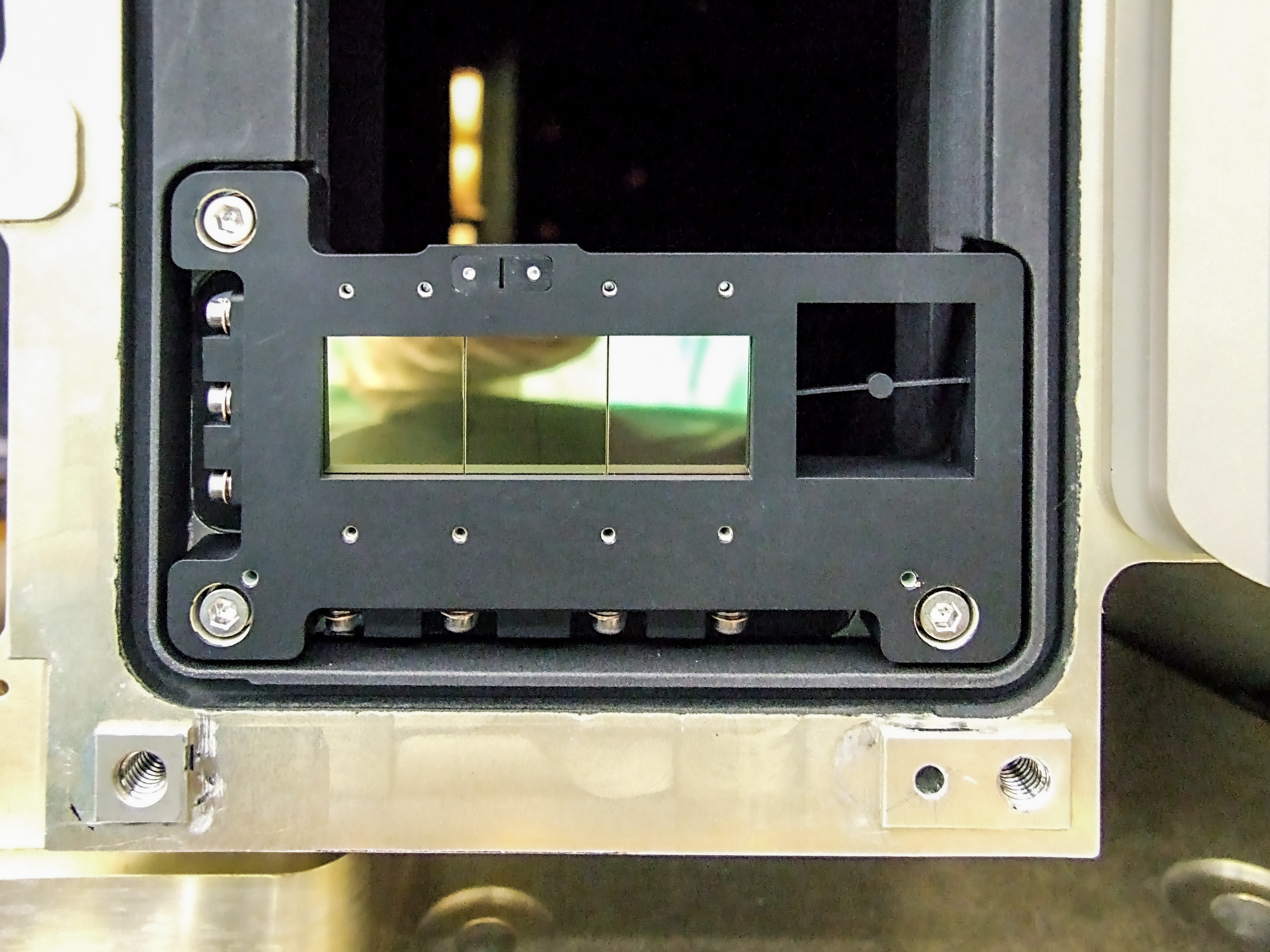
The James Webb Space Telescope (JWST) has all these features! In particular, the MIRI (Mid-Infrared Instrument) observes in the mid-infrared and has a coronagraph (see Figure 1) designed at LIRA at Paris Observatory and manufactured by CEA.
It was this technique that enabled a research team led by a LIRA researcher to discover a new exoplanet, the first to be discovered by the JWST.
Rings in discs of debris
The JWST was not designed to discover exoplanets, but rather to study them with great precision once they have been discovered by other telescopes. In fact, its field of view is not suited to observing many stars at the same time, which considerably slows down the discovery process.
To make this discovery, the team of scientists had to focus on the most promising debris discs: systems that are only a few million years old. In these systems, the planets that have just formed are still hot, which makes them more luminous in the thermal infrared than their older counterparts, making it easier to detect smaller planets. What’s more, these systems are viewed from the pole of their star from Earth, a configuration that allows us to see the discs "from above".
Among these candidates for hosting planets in formation, two in particular have caught the researchers’ attention. Previous observations had revealed concentric annular structures within them, suspected to be the result of gravitational interactions between unidentified planets and planetesimals, i.e. planets in formation.
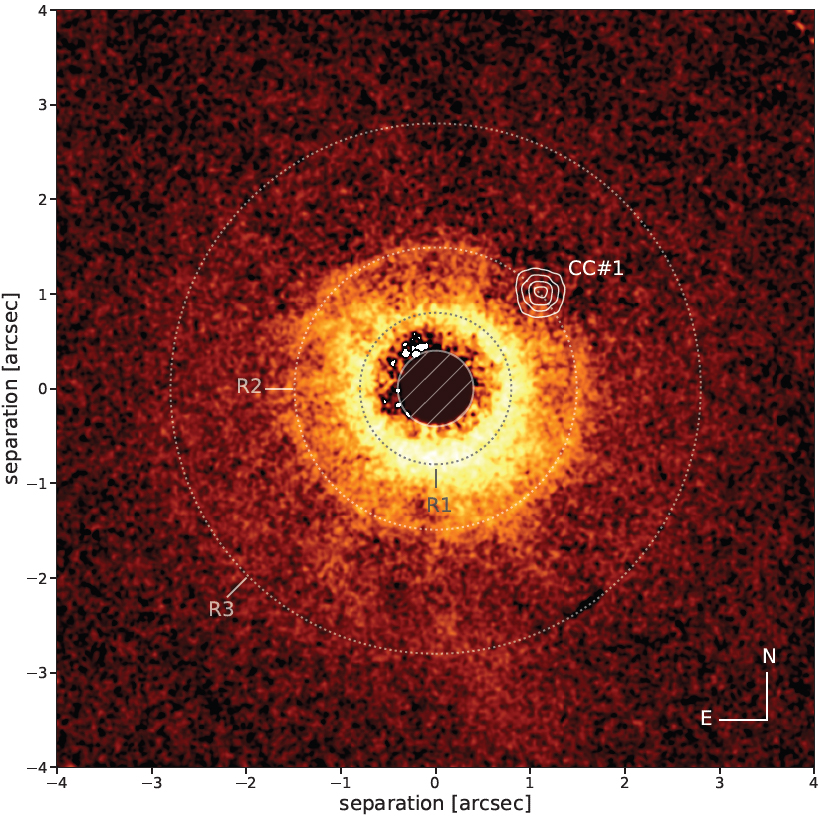
One of the two systems, called TWA 7, has three distinct rings, one of which is particularly thin, surrounded by two regions almost empty of matter (see Figure 2). When scientists pointed the JWST at this system, the image obtained revealed a source at the very heart of this thin ring. After eliminating the hypotheses of a potential observational bias, the scientists came to the conclusion that this is very probably an exoplanet. Detailed simulations have indeed confirmed the formation of a thin ring and a ’hole’ at the exact position of the planet, in perfect agreement with the observations made by JWST.
What are the prospects for future discoveries of exoplanets?
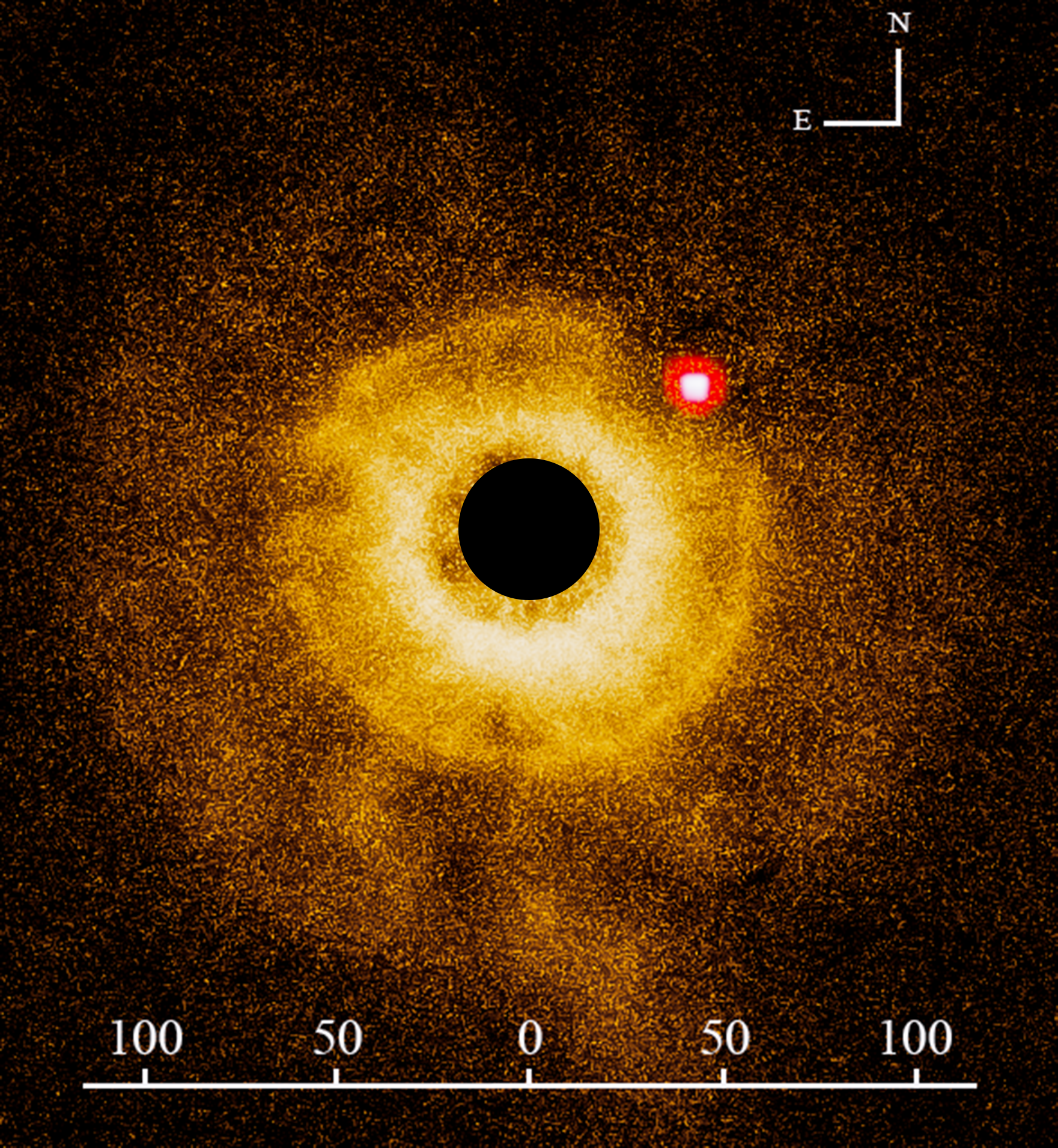
Named TWA 7 b, this new exoplanet is ten times lighter than those imaged to date! Its mass is comparable to that of Saturn, or around 30% of that of Jupiter, the most massive planet in the Solar System.
This result marks a new milestone in the search for and direct imaging of lighter and lighter exoplanets. The JWST has the potential to go even further in the future. Scientists hope to be able to image planets as small as 10% of the mass of Jupiter. This discovery opens the way to imaging Earth-like exoplanets. These will be the target of future generations of space and ground-based telescopes, some of which will also use more sophisticated coronagraphs. The most promising candidate systems are already being identified for these future observations.
This project was funded by the European Research Council (ERC) as part of the European Union’s Horizon 2020 research and innovation programme (COBREX; grant # 885593). https://cobrex.lesia.obspm.fr
To go further
Scientific contacts LIRA
- Anne-Marie Lagrange (anne-marie.lagrange@obspm.fr)
- Anthony Boccaletti (anthony.boccaletti@obspm.fr)
Contact presse
- Fabien Fichet (Fabien.Fichet@obspm.fr, +33 1 40 51 21 55)