The formation and evolution of the Milky Way
The Milky Way’s disc is a vast, rotating collection of stars, flattened like a pancake, with spiral arms extending out from the centre. It contains the majority of the Galaxy’s stars, including the Sun, and rotates at a speed of over 220 kilometres per second. Astronomers have long sought to determine when this disc formed, that is, the moment when the stars began to rotate around the galactic centre in a coherent manner. This stage marks what scientists call the Galaxy’s ‘initial rotation phase’.
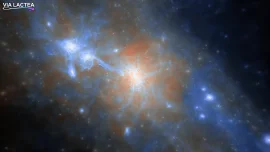
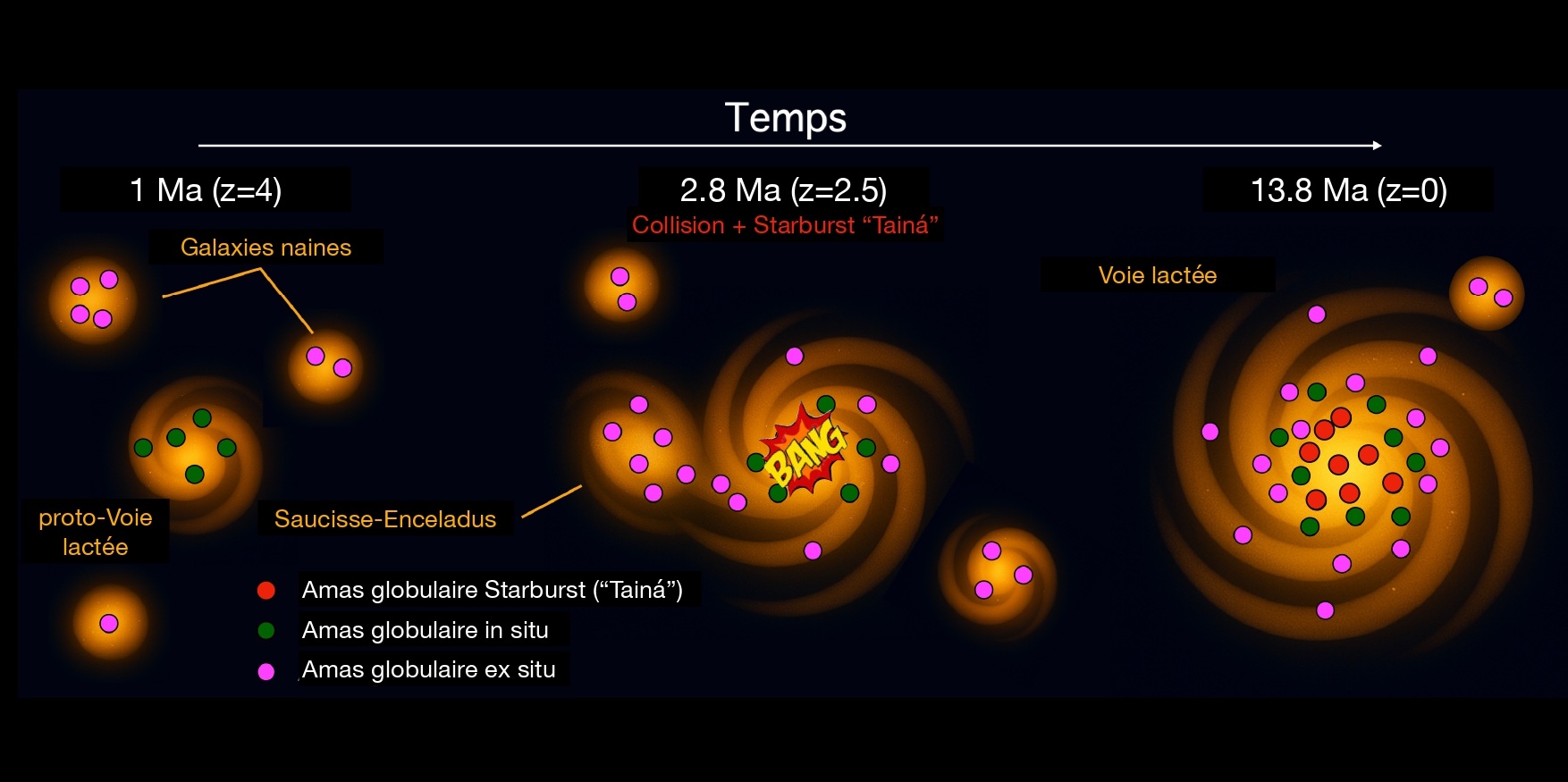
In the Universe, a galaxy does not form in isolation : it constantly interacts with the intergalactic medium, which supplies it with matter and energy. Similarly, the Milky Way as we know it today is the result of a long process, spanning several billion years, marked by successive mergers with objects of varying sizes, some of which have left traces that can still be observed today. Indeed, under the influence of tidal forces, galaxies that collide with the Milky Way are gradually torn apart, transferring their stars to our Galaxy (see Figure 1). These stars possess properties — chemical composition, age and motion — that differ from those formed locally. The study of stellar populations found in globular clusters, the galactic halo and the galactic disc thus enables astronomers to reconstruct the Milky Way’s turbulent past.
Several decades ago, scientists put forward the hypothesis of a major collision between the nascent Milky Way and a dwarf galaxy known as Gaia-Sausage-Enceladus. Although its mass was only between one-tenth and one-quarter of that of the early Milky Way, it is thought to have played a decisive role in the formation of the Galaxy as we know it today. This hypothesis was confirmed in 2018 thanks to data from the Gaia mission, which revealed a large population of stars with very different orbits and chemical properties. These characteristics can only be explained by a massive merger that occurred around 10 billion years ago, which significantly disrupted their trajectories. Some of these stars now make up the galactic halo. This event is now known as the Gaia-Sausage-Enceladus (GSE) merger.
Travelling back in time through simulations
| Figure 2 : Simulation of the evolution of a spiral galaxy similar to the Milky Way over 13.5 billion years.
At the centre lies a galaxy similar to what the Milky Way may have been like in the past, in constant interaction with smaller galaxies that are gradually merging with it. Around 11 billion years ago, a massive galaxy, approaching from the left, collided with the main galaxy, disrupting its stellar disc and having a lasting impact on its evolution. Dark matter is shown in grey, whilst cosmic gas is coloured. The colours indicate the temperature of the gas : the coldest regions appear blue and the hottest red. Credits : Matt Orkney & Chervin Laporte, MNRAS (2026). |
Gaia’s observations provide a snapshot of the Milky Way today and offer clues about its past, but they do not allow us to trace the evolution of our Galaxy with precision, given the multitude of possible scenarios. To better understand its history, astronomers use numerical simulations, which reproduce different evolutionary scenarios based on the physical laws governing galaxy formation. In this study, the researchers used the Auriga cosmological simulations, a set of numerical models tracking the formation and evolution of 30 galaxies similar to the Milky Way, from 300,000 years after the Big Bang to the present day, spanning 13.5 billion years (see Figure 2). These simulations reproduce the main physical phenomena at work in galaxies, such as gravity, gas movements, star formation and chemical enrichment, in order to trace their evolution throughout the history of the Universe. The researchers were thus able to test their method for dating major galactic collisions in general terms before applying it to the case of the Milky Way.
The simulations have revealed several groundbreaking findings. Firstly, they show that the initial rotation phase — that is, the moment when the galactic disc begins to rotate — often begins much earlier than previously thought. However, this disc can be partially or completely destroyed during major galactic collisions. Thus, the moment when the Milky Way’s disc begins to rotate would not necessarily correspond to its initial formation, but rather to the reconstruction phase following a destructive merger.
The second finding concerns the dating of the Gaia-Sausage-Enceladus merger. Researchers estimate that it likely took place around 11 billion years ago, which is earlier than many previous estimates had suggested. This period also coincides with a phase of intense star cluster formation in the Milky Way, which the researchers have named ‘Tainá’ in their paper. Such bursts of star formation are a natural consequence of galactic collisions, which compress the gas and trigger increased activity.
Models of the Gaia-Sausage-Enceladus merger predict that a veritable galactic fireworks display must have followed the impact, stimulating star formation and promoting the formation of globular clusters. This is the first time this link has been established,” explains Chervin F. P. Laporte, a researcher at the CNRS and co-author of the study. “This work highlights the essential link between galactic structure and ancient collisions, two elements that must be understood together to grasp the history of our Galaxy.”
This research highlights the fundamental link between galactic structure and ancient collisions, two phenomena that must be understood together to comprehend the history of our Galaxy, adds Matthew D. A. Orkney, a researcher at ICCUB and IEEC and lead author of the study.
The distant universe as a laboratory for galactic evolution

Although scientists cannot travel back in time to observe the early days of the Milky Way directly, they can nevertheless study the formation of similar galaxies in the distant Universe thanks to observations from the James Webb Space Telescope (JWST) and the ALMA network (see Figure 3). In fact, observing galaxies at great distances is akin to travelling back in time : the light they emit takes billions of years to reach us. Thus, the more distant a galaxy is, the further back in the Universe’s history it is observed, and therefore at an earlier stage of its evolution. By comparing these different stages, astronomers can reconstruct and better understand the evolution of a galaxy like our own.