GRAVITY+ pushes the boundaries and uncovers a record-breaking star
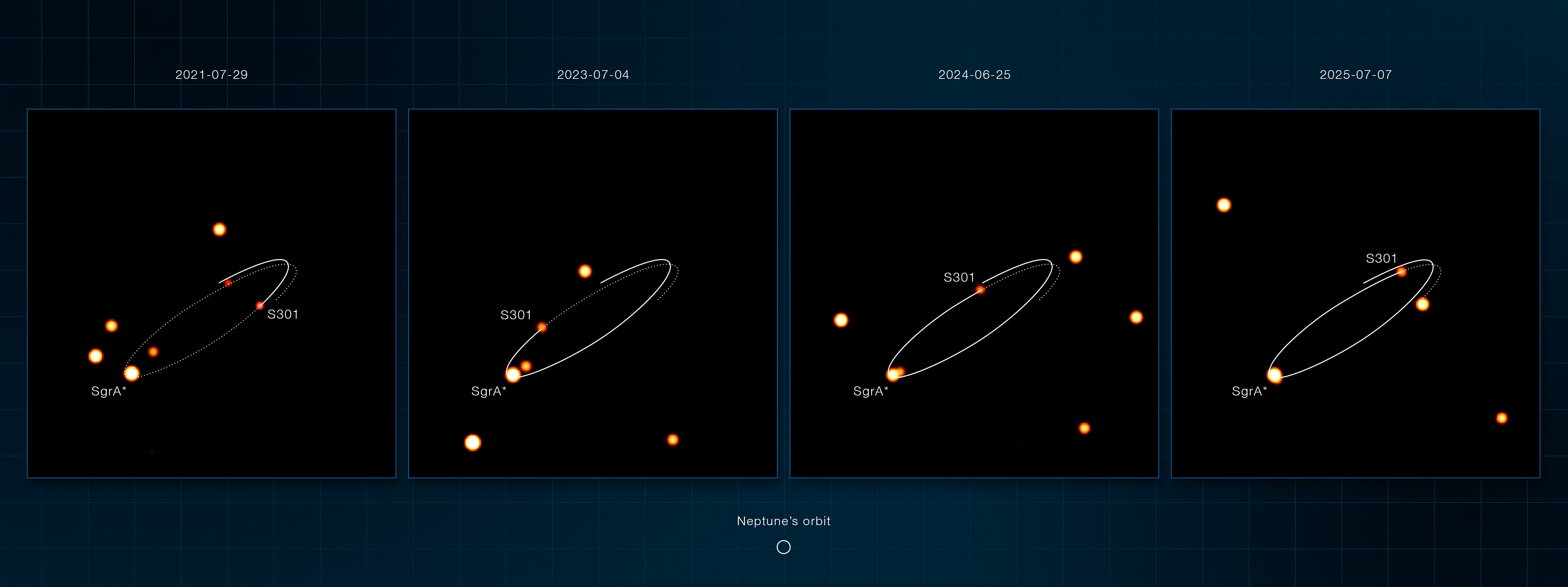
For many years, a systematic observation programme – in which the LIRA team is involved – has been working to map, with ever-increasing precision, the vicinity of Sagittarius A* (Sgr A*), the supermassive black hole with a mass of 4.3 million solar masses located at the centre of our Galaxy. LIRA has notably contributed to the design of GRAVITY, which combines the light from the four giant telescopes of ESO’s Very Large Telescope (VLT) in Chile. The instrument has enabled the frenzied dance of the stars around Sgr A* to be observed with unprecedented precision. Among them, S29 previously held the speed record, reaching nearly 8,740 km/s – 3 per cent of the speed of light – as it passed closest to the black hole. By way of comparison, the Earth orbits the Sun at just 29.8 km/s.
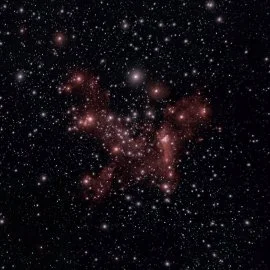
As observational techniques advance, astronomers are able to detect stars that are ever fainter and closer to the black hole. GRAVITY is therefore evolving into GRAVITY+, a significantly improved version to which LIRA is actively contributing. New adaptive optics systems, laser guide stars and new methods of data analysis are pushing the instrument’s limits even further. It was thus in the spring of 2023 that a previously invisible star appeared : S301 (see Figure 1). By tracking its orbit, scientists discovered that it smashes the previous record set by S29, reaching 25,000 km/s – nearly three times as fast. This discovery directly illustrates how the continuous improvement of observational techniques is revealing celestial bodies that were previously beyond our reach.
And S301 is breaking record after record. It completes one revolution around the black hole in just 8.7 years, in a highly elliptical orbit that brings it, at its closest, to within just 12 astronomical units of Sgr A* — roughly the distance between the Sun and Saturn. It thus becomes the star known to have the shortest orbital period and the tightest orbit around the galactic centre, passing ten times closer to the black hole than the closest star known until then. This feat is all the more remarkable given that S301 shines two billion times fainter than Betelgeuse, in the midst of a region where light sources are almost indistinguishable. Picking out its signal is like hearing the buzz of a fly amidst a symphony orchestra ! Yet it was possible to distinguish it from its neighbours by a mere few milliseconds of arc : a level of precision that, from Earth, would allow one to distinguish an object on the Moon the size of the Apollo lunar module.
“The discovery of S301 is no coincidence. It is the result of a long-term endeavour,” says Thibaut Paumard, co-investigator on the GRAVITY+ project and deputy director of LIRA, “with the development of several adaptive optics systems from the 1990s onwards, the GRAVITY instrument, which was commissioned in 2017 after more than ten years of development, followed by its upgrade, GRAVITY+, in 2024, and soon MICADO, which has also been under development for several years. At the same time, we are also developing the digital tools that enable us to compare observational data with theoretical predictions, such as the Gyoto software for calculating trajectories and gravitational lensing effects.”
S301 paves the way for the first measurement of a black hole’s rotation
Tracking a star so close to Sagittarius A* presents a real technical challenge, but also a unique opportunity to test general relativity in one of the most extreme gravitational environments in our Galaxy. To determine the orbit of S301, scientists analysed several years’ worth of observations in order to track its position precisely. Its proximity to the black hole changes the situation considerably :
“Without this star, we would have to measure the orbits of the other stars for several more decades in the hope of detecting an effect caused by the rotation of Sagittarius A*,” explains Juan Osorno, a postdoctoral researcher at LIRA.
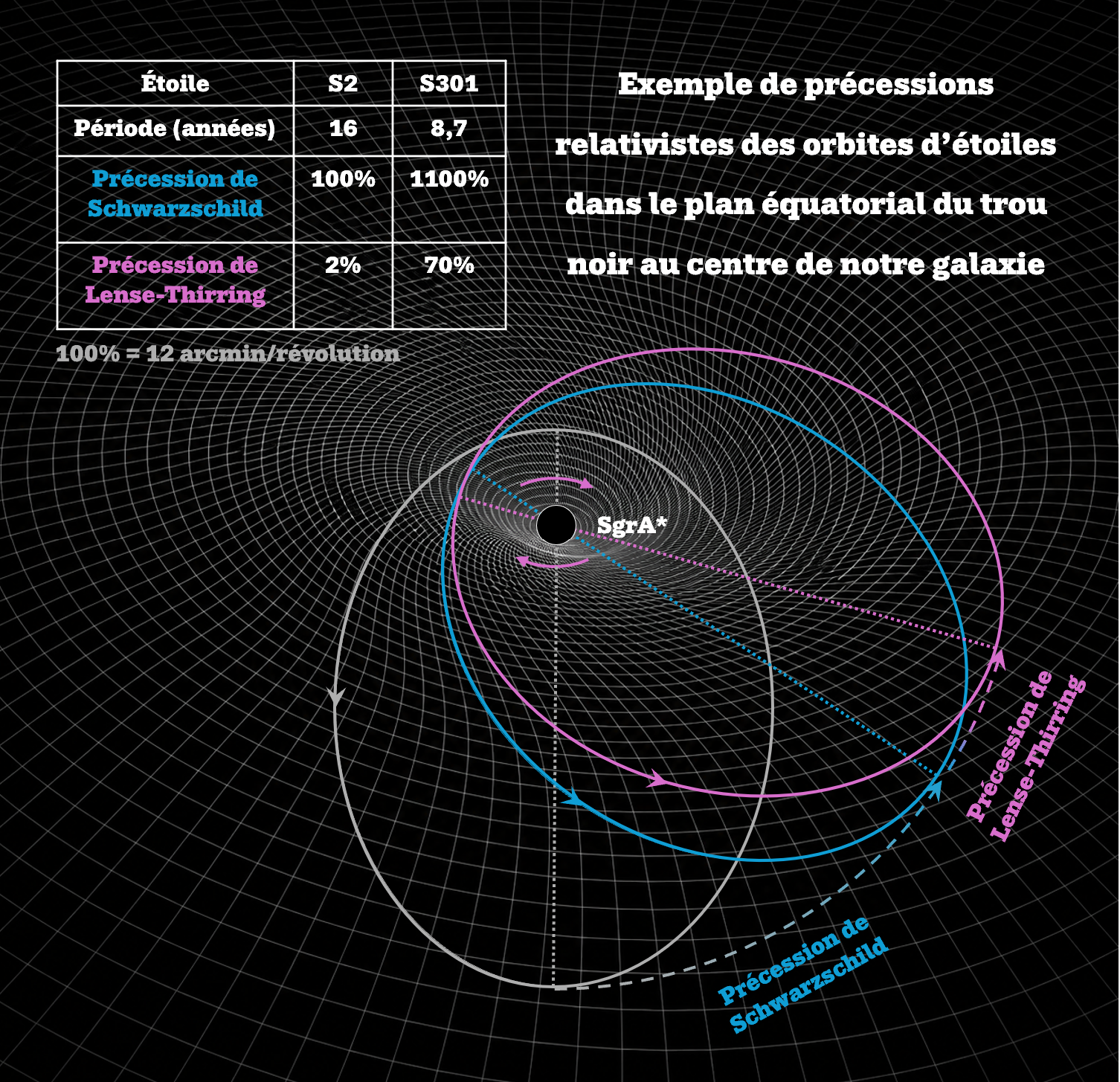
For around a black hole, Newton’s laws no longer apply. The orbit of S301 gradually deviates from the ellipse predicted by these laws, revealing the effects of general relativity (see Figure 2). The first, Schwarzschild precession, is caused by the curvature of space-time due to the black hole’s mass : with each orbit, the point at which the star passes closest to Sgr A* shifts slightly, gradually tracing a sort of rosette pattern. This effect has already been observed with the star S2. But by venturing much closer to the black hole, S301 becomes susceptible to a second, far more subtle phenomenon : Lense–Thirring precession, caused this time by the black hole’s rotation — or spin — (see Figure 3).
“What I find particularly fascinating about S301 is that it finally gives us a chance to directly observe an effect linked to the rotation of a black hole. A rotating black hole does not merely warp space and time around it : it literally drags them along in its rotation. This effect, known as Lense-Thirring precession, is extremely weak and has never before been measured around a black hole. S301 passes close enough to Sagittarius A* for this minute distortion of space-time to leave a measurable trace in its orbit. By continuing to track this star over the coming years, we could therefore use its motion as a tool to measure the rotation of the black hole at the centre of our Galaxy, explains Abd El Dayem Karim, a former PhD student at LIRA.”
S301, a new laboratory for general relativity
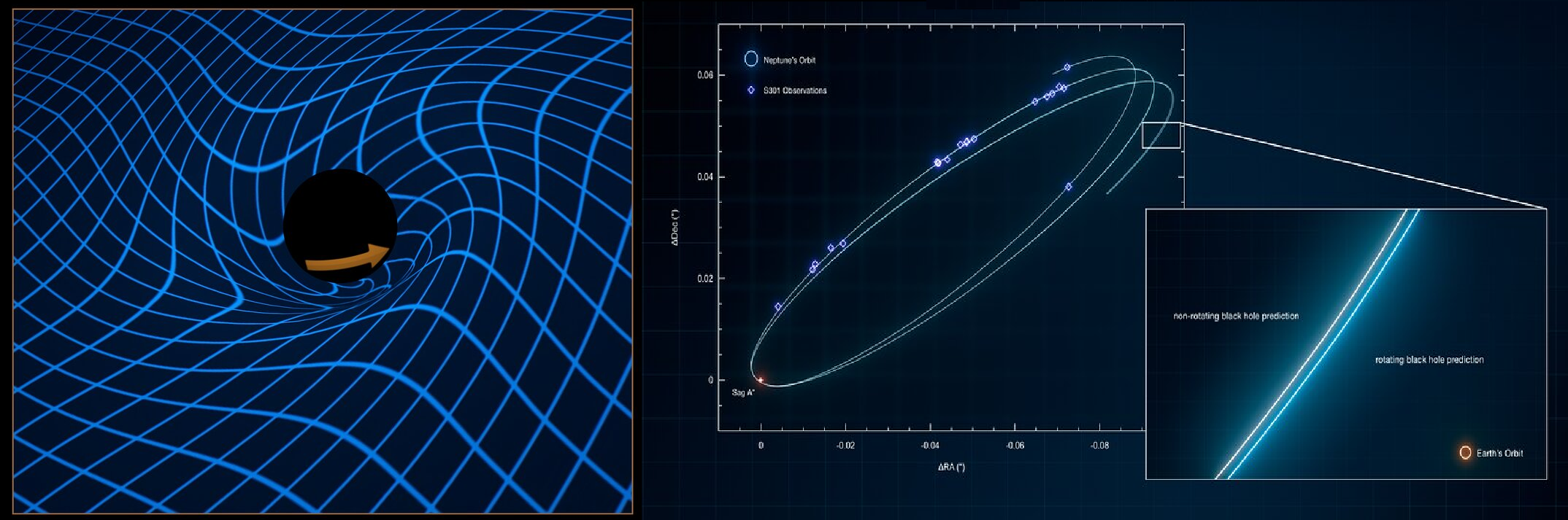
Unlike the hot gas observed around other black holes, such as that in M87 imaged by the Event Horizon Telescope, S301 offers a valuable advantage : its motion can be tracked directly. By combining the extremely precise measurements of its position obtained with GRAVITY+ and those of its radial velocity taken with MICADO, a future instrument on ESO’s Extremely Large Telescope (ELT), scientists will be able to reconstruct its three-dimensional motion and thus directly measure the rotation of Sgr A*.
But to achieve this, it will be necessary to disentangle several effects that could perturb its orbit.
“The effect produced by spin on the motion of the star S301 is similar to that caused by the presence of a disc — that is, a flattened distribution — of non-luminous matter that may lie around the supermassive black hole Sgr A*. We will therefore need to determine both effects simultaneously, which opens up the possibility of gaining a better understanding of the environment surrounding Sgr A* by measuring the non-luminous mass around it,” explains Arianna Foschi, a postdoctoral researcher at LIRA. ”
The challenge thus becomes an opportunity : S301 could both reveal the black hole’s rotation and probe the invisible matter surrounding it.
In the longer term, the aim is to go even further by testing the Kerr metric, which describes the space-time around a rotating black hole.
“General relativity predicts that a black hole is fully described by just two parameters : its mass and its spin,” explains Frédéric Vincent, a research fellow at LIRA. “This fundamental result is known as the no-hair theorem (the ‘hair’ symbolising the lack of complexity in the black hole object). The star S301 will enable us to determine whether the black hole is distorted by its rotation, in the same way that the Earth is flattened by its rotation. This deformation, if it exists, must depend on the two parameters of mass and spin, according to the no-hair theorem. Verifying this prediction of general relativity would constitute a major test of our understanding of gravity in its most extreme regime.”
And the prospects already extend beyond S301 and the centre of our Galaxy.
“This new result obtained with GRAVITY on our galactic centre demonstrates the power of long-baseline interferometry, which has reached full maturity with the instrument on the VLTI,” emphasises Guy Perrin, an astronomer at the Paris Observatory and co-investigator on the GRAVITY project. “In its GRAVITY+ version, GRAVITY will be able to broaden the scope of possibilities and focus on a very large number of supermassive black holes. It also opens up new horizons for future instruments with much longer baselines, whose resolving power will be even greater, with the potential to reach scales that are currently inaccessible – just as GRAVITY did more than twenty years ago.”
