In addition to its permanent researchers and engineers, LIRA brings together around 30 post-docs and 50 PhD students.
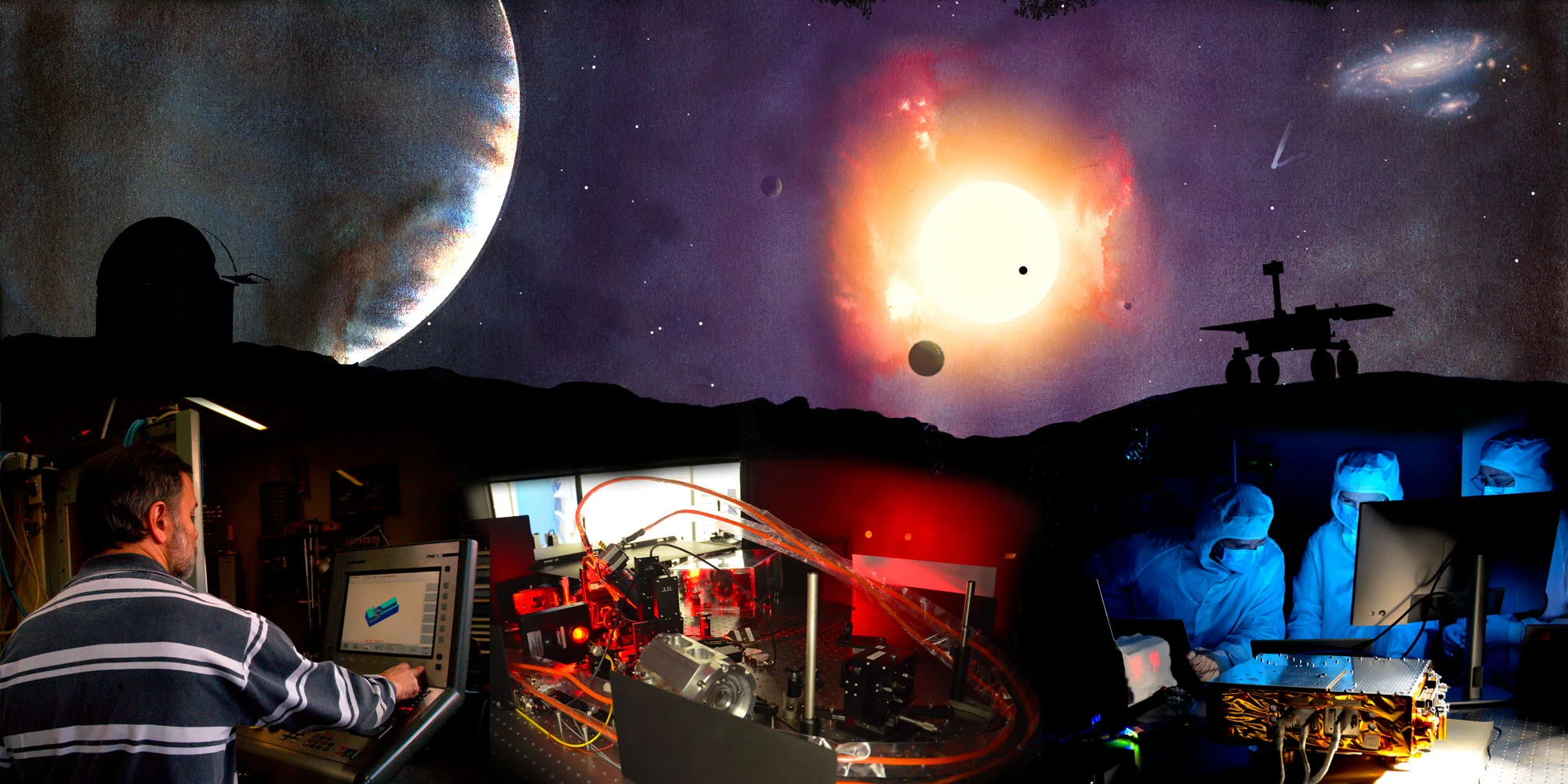
LIRA’s main scientific themes are the study of “sun-planet” and “star-exoplanet” systems, terrestrial and (exo-)planetary atmospheres, star-resolved galaxies and stellar populations, with the development of space and ground-based instrumentation, laboratory experimentation and data observation and analysis as dominant methodologies.
LIRA is the result of a recent merger of teams from LESIA, LERMA and GEPI, and is dedicated to the design and production of space and ground-based scientific instrumentation, as well as the exploitation of the resulting observations.
Its activities are divided into five scientific divisions :
- Stars and Galaxies,
- High Angular Resolution in Astrophysics,
- Heliosphere and Astrophysical Plasmas,
- Planetology,
- Exoplanetary Systems.
LIRA is a department of Observatoire de Paris-PSL and a joint research unit of the Centre national de la recherche scientifique (CNRS), UMR-8254, associated with Sorbonne Université, Université Paris Cité and Cergy Paris Université.
Affiliation to be stated in publications
LIRA, Observatoire de Paris, Université PSL, Sorbonne Université, Université Paris Cité, CY Cergy Paris Université, CNRS, 92195 Meudon, France