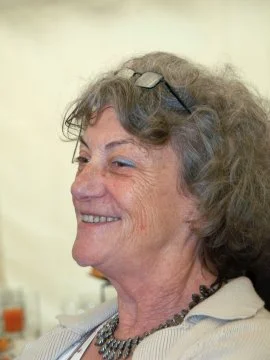
It is with great sadness that we learn of the death of Annie Baglin.
Annie began her career in astrophysics with a thesis on the evolution of hot degenerate stars, supervised by Evry Schatzman and defended in 1967 at the Paris Institute of Astrophysics (IAP).
She joined the CNRS in 1968 and moved from the IAP to the Nice Observatory the following year. There, for nearly twenty years, she continued her theoretical work exploring the internal structure of stars.
During this period, she took an interest in the development of stellar evolution codes, an interest which led her in the 1980s to champion the development of the French CESAM code within the GdR 131 Internal Structure research group. It was also during this time that she launched the internal structure schools – autumn schools which have continued in their current form as the Evry Schatzman Schools of the PNPS.
She very quickly recognised stellar pulsations as a promising source of information for studying the internal structure of stars. She subsequently supervised several PhD theses in this field and collaborated on ground-based stellar pulsation observation projects. She also forged links with the DESPA team at the Paris Observatory, which advocated the need for space-based observations.
In the 1980s, she also became enthusiastic about ESA’s Hipparcos space mission, the world’s first space-based astrometry mission, and helped to compile its initial catalogue under the guidance of Catherine Turon.
In 1988, she joined the Paris Observatory as head of the DASGAL in-house team, replacing Françoise Praderie to lead the EVRIS project – a stellar seismology experiment scheduled to observe during the journey aboard the Russian MARS96 probe, intended for the exploration of Mars.
In 1996, EVRIS was launched… and immediately lost, but Annie rallied the community behind CoRoT, a new space-based stellar seismology project. Under her leadership, and after overcoming numerous obstacles, CoRoT’s programme was expanded to become the first space mission to search for exoplanets via the transit method, now involving not only the Paris Observatory, but also the LAM in Marseille, the Toulouse Observatory, the Nice Observatory and more than twenty institutes across Europe and Brazil. CoRoT was finally approved and launched in 2006, with the success we are all familiar with.
Annie was thus a key figure in the development of stellar seismology at the Paris Observatory, at DASGAL, and subsequently at DESPA and LESIA. The CoRoT mission, which she championed on the international stage, was a major achievement for CNES and its international partner agencies. It was CoRoT, launched in 2006 and led by Annie Baglin, that truly marked the starting point for space-based stellar seismology and the search for exoplanets via transits from space. By championing (with all her might !) and then leading the CoRoT project, Annie helped to develop and shape a large and dynamic community with strong roots in Europe.
Until 2018, following her retirement and appointment as professor emeritus, Annie worked to promote the legacy of CoRoT and to prepare for the future.
Annie’s legacy lives on today in the PLATO mission, in which the French community and LIRA are key drivers, particularly through the major contribution that the open-source Cesam2k20 code for stellar internal structure and evolution now makes to the mission.
Beyond her own research, Annie also played a major role in the management and leadership of astrophysics in France : as director of the DASGAL laboratory at the Paris Observatory, a member of Section 14 of the CNRS, and vice-chair of the Scientific Council of the Paris Observatory. And throughout all her activities, Annie was always committed to supporting and encouraging young women to pursue a career in research.
All those who worked alongside her in her many and varied activities, both professional and personal, will remember with fondness her enthusiasm, her energy and her immense human qualities. Many of us feel privileged to have had her as a colleague and friend, and to have benefited, at one time or another in our careers, from her support and her example.
We wish to express our condolences to her family, to her son Jérôme, to her grandchildren, and to her brother Gérard.
