An extraordinary operation in Meudon
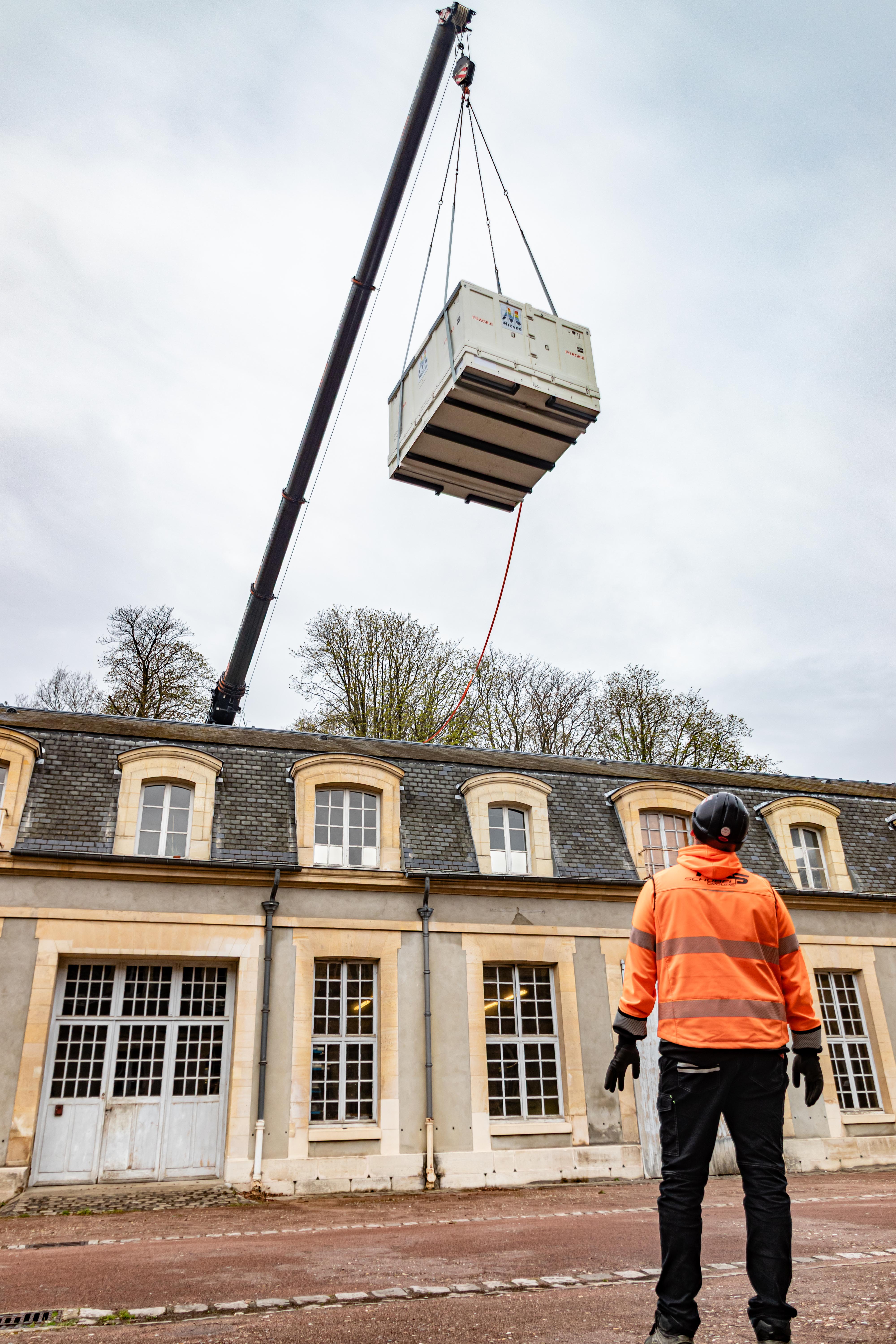
On 16 March, the Communs site in Meudon was the scene of a spectacular logistical operation: the crane-assisted delivery of the MICADO adaptive optics bench (see Figure 1). Having arrived on site that morning via a special heavy-goods convoy, the crate containing the equipment — weighing 1.3 tonnes on its own — required meticulous planning.
Manufactured in Germany by CarbonVision, this carbon-fibre bench, designed by LIRA, boasts impressive dimensions: over 2.5 metres in diameter, nearly 1.5 metres in height and weighing around half a tonne. Added to this is a specialised 750 kg pallet truck. The entire assembly, packed in a custom-made crate measuring 3.8 × 3.3 × 2.5 metres and weighing a total of around 3 tonnes, meets the requirements for future transport to Chile.
On the day, a 60-tonne mobile crane was brought in to lift the container off the lorry, swing it over the Communs buildings, and set it down in the inner courtyard, opposite the UNIDIA reception hall. The operation continued with an even more delicate manoeuvre: using the crane to turn the carriage and bench upright, placing them on rolling supports, moving them to the overhead crane in the integration hall, and finally turning the carriage and bench back to a horizontal position.
This manoeuvre involved numerous teams: scientists and engineers from LIRA and UNIDIA, logistics and safety services from the Paris Observatory-PSL and LIRA, as well as the communications teams from LIRA and the CNRS. ULISSE, the CNRS unit specialising in the transport of scientific instruments, provided its expertise for the design of the crate and the organisation of the transport. GT Logistics handled the transport and coordinated the handling operations, whilst MS Levage carried out the handling itself.
MICADO, the ELT’s first-light instrument
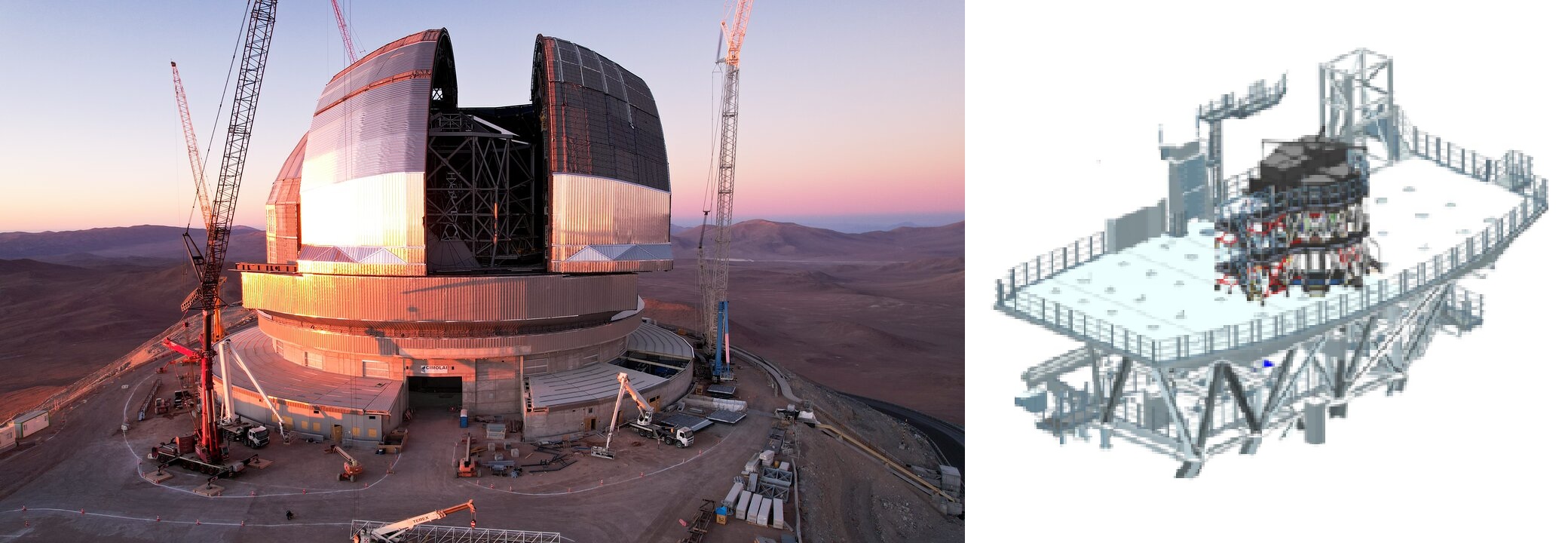
MICADO (Multi-Adaptive Optics Imaging Camera for Deep Observations) is the first-light imager for the Extremely Large Telescope (ELT), a giant 39-metre telescope (see Figure 2) currently under construction in Chile by the European Southern Observatory (ESO). Its first scientific observations are scheduled for around 2030.
This state-of-the-art instrument will enable major advances in astrophysics, particularly in the study of the formation of the first galaxies and the detection of exoplanets in the habitable zone of their host stars. To achieve these objectives, MICADO will operate in the near-infrared (0.8–2.4 μm), like the JWST, whilst offering angular resolution up to six times higher at equivalent sensitivity.
To reach the diffraction limit of the ELT and thus fully exploit the potential of the 39-metre telescope, MICADO relies on adaptive optics systems capable of correcting atmospheric disturbances in real time. Among these, the SCAO (Single Conjugate Adaptive Optics) mode, which uses a natural star to analyse atmospheric turbulence, is being developed within the MICADO consortium under the leadership of LIRA, with contributions from several French laboratories.
The MICADO SCAO bench
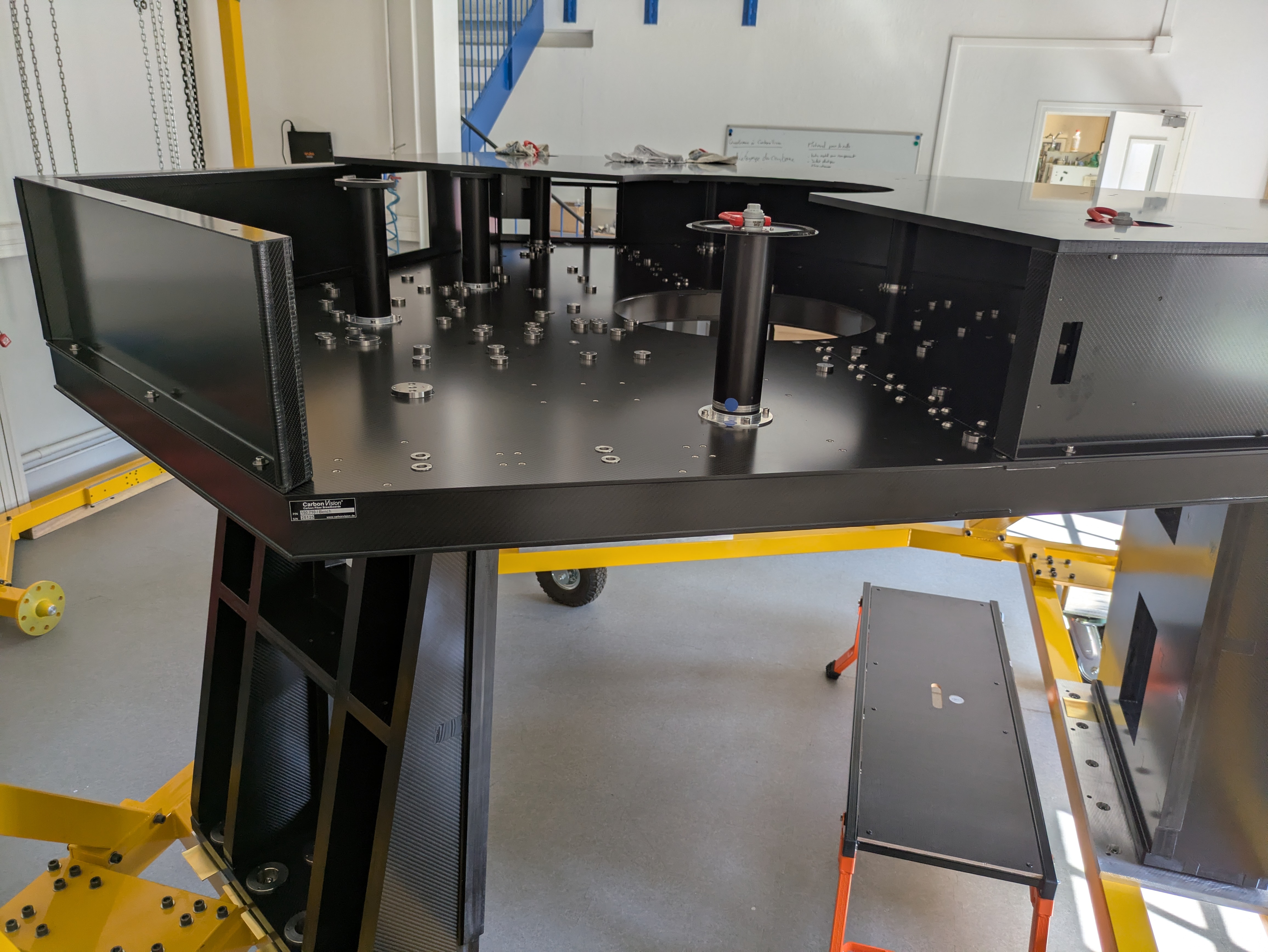
The bench delivered to Meudon is designed to support the various opto-mechanical subsystems of MICADO’s SCAO: its wavefront analyser, its calibration system and its dichroic mirror, which reflects visible light from the telescope towards the SCAO’s wavefront analyser whilst transmitting infrared light to the scientific camera.
This bench is a complex assembly of epoxy carbon fibre and aluminium honeycomb. It comprises baffles, a segmented cover, support and stiffening columns, and, most importantly, a multitude of inserts. These are metal parts passing through the bench and serving as fixing points for the various opto-mechanical elements of the SCAO.
The bench’s specifications presented a real challenge for CarbonVision: the absolute positioning of the optical elements is guaranteed to within a tenth of a millimetre on the bench’s surface, and the flatness of the bench’s top and bottom surfaces is 5 hundredths of a millimetre per metre!
The bench will remain in Meudon until 2028, where the teams will carry out the system’s integration and testing phases, before it is transferred to Germany for the final assembly of the MICADO instrument. This key stage forms part of a major French contribution to the project, particularly in the areas of adaptive optics and high-contrast imaging dedicated to the study of exoplanets.
Several laboratories are involved in these developments — LIRA, UNIDIA, LMA, LCF, Theta — alongside the technical division and the EFISOFT unit of INSU, demonstrating France’s expertise in cutting-edge scientific instrumentation.
Supported by funding from the Île-de-France Region’s DIM ORIGINES, the F-CELT project under the Investments for the Future Programme, the CNRS/INSU, the Paris Observatory – PSL and the European Southern Observatory (ESO), the MICADO project is at the heart of the major research infrastructures that will shape 21st-century astronomy.
Contact : Yann Clénet (yann.clenet@obspm.fr)
For more information:
