A successful test campaign for the AIRS instrument
The development of space hardware requires several intermediate models to progressively validate the mechanical, thermal, electrical, and software design. Structural and Thermal Models (STM), for example, are used to validate the mechanical and thermal design, while Avionics Models (AVM) and Engineering Models (EM) are used to perform complete electrical and functional validation. The flight model is then produced based on these results, or alternatively on a qualification model that incorporates all the equipment’s functions.
As part of the development of the AIRS instrument, and particularly of the cold section of the spectrometer, the engineering model was designed as a qualification model with the objective of fully validating its design, especially with respect to the ARIEL mission’s space-environment requirements, both mechanical and thermal. Alongside these tests, an extensive calibration campaign has been underway since March 2026 to measure the instrument’s performance, including the acquisition of the spectrometer’s first image.
The AIRS instrument consists of an electronic unit, the ADCU (AIRS Detector Control Unit), and the spectrometer’s cold section, the CU (Cold Unit), which includes two optical benches coupled to two focal planes in order to cover the wavelength range from 1.95 to 7.8 microns. CEA develops the detector readout chains, from the detectors mounted on the focal plane through to the complete ADCU control unit. IAS is responsible for the two optical benches, their integration and alignment, as well as the measurement of their physical properties and vibration testing.
The optical benches are composed of several subsystems (lenses, prisms) mounted in mechanical supports. These subsystems are assembled and tested at IAS, where their optical characteristics are verified and their ability to withstand launch loads is assessed.
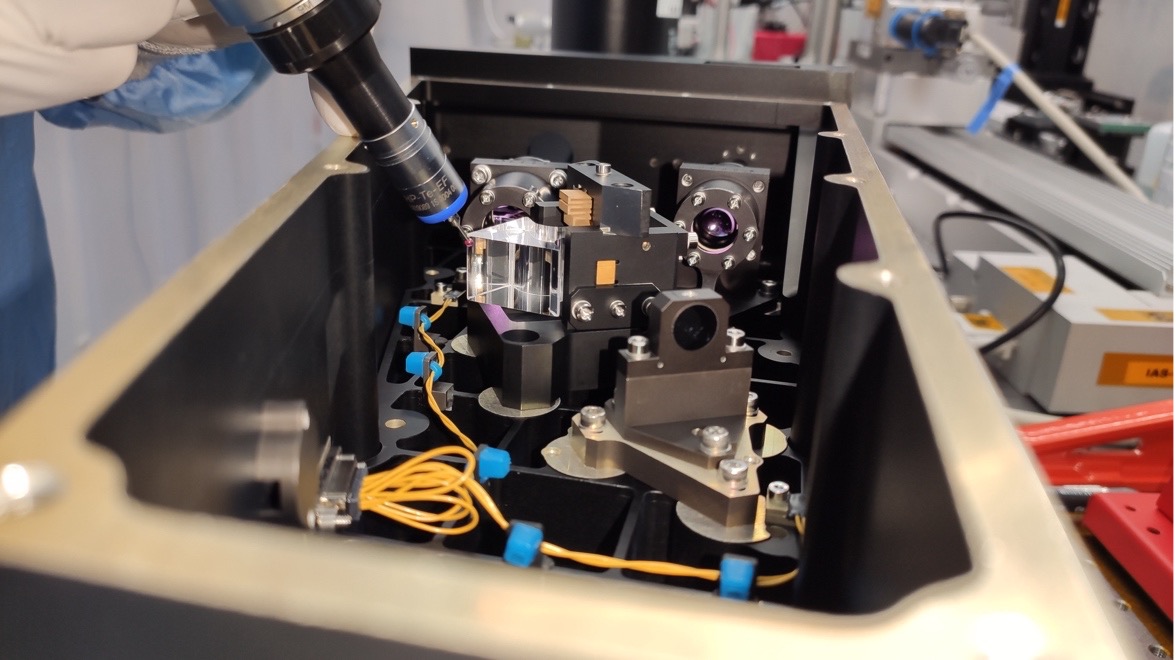
Once the optical benches have been assembled and aligned, the focal planes are mounted onto them. All assembly operations are performed in a clean room to ensure that no dust or contamination is deposited on the optics, which could otherwise degrade the instrument’s performance.
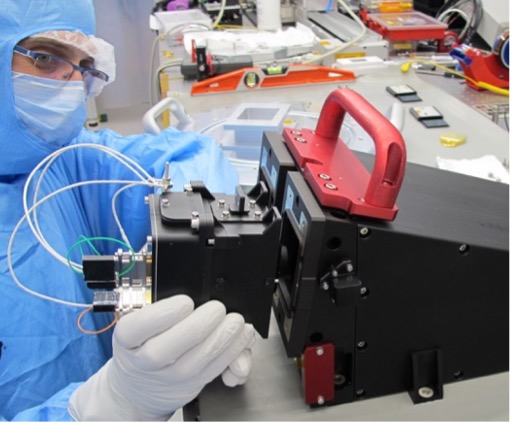
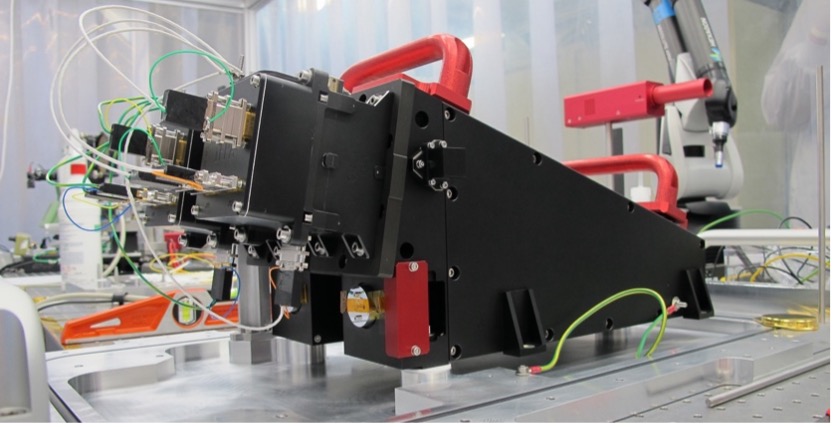
Once the entire assembly—optical benches plus focal planes—is complete, vibration tests are carried out using the IAS shaker facility. The integrity of the instrument is then verified, along with the relative alignment of the two optical benches, to ensure that no deformation has occurred during testing.
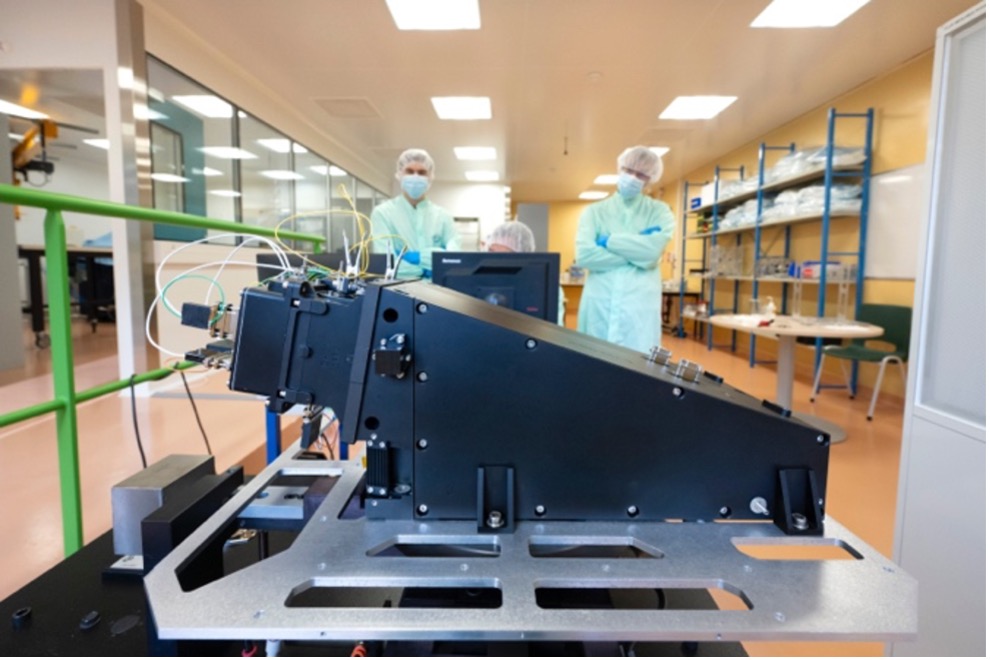
The cold section is then shipped to LIRA for thermal testing and instrument calibration.
Since March 2026, the engineering model of the AIRS infrared spectrometer has been installed at LIRA in the SimEnOm cryogenic vacuum chamber of the MESPAL facility. This chamber reproduces conditions close to those encountered in space and allows verification of the instrument’s proper operation.
LIRA is responsible for the entire test campaign : it provides the test equipment, including an optical bench that simulates the telescope, and performs all measurements required to assess the instrument’s performance.
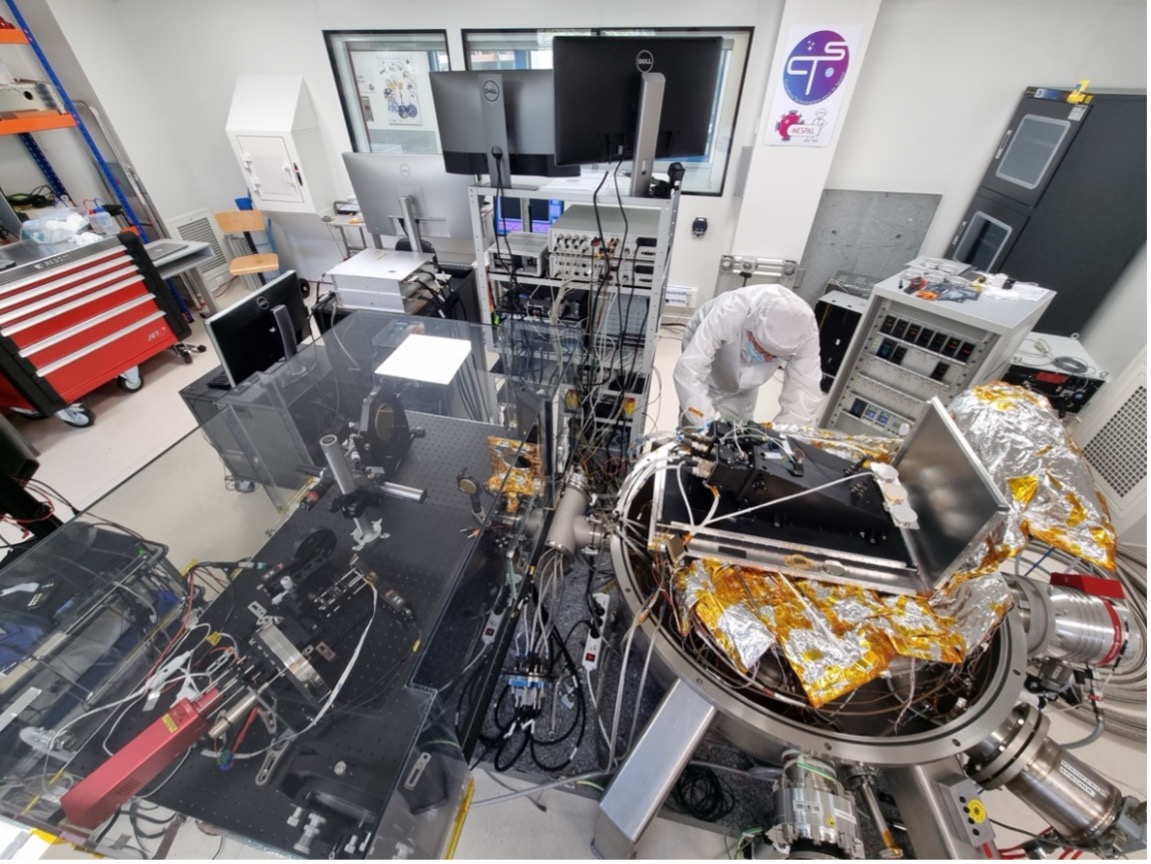
These tests will continue until November 2026, with the participation of scientific teams from CEA, IAS, and IAP. Once this phase is complete, the instrument will be delivered to the Rutherford Appleton Laboratory (RAL) in the United Kingdom for additional testing together with all systems integrated into the ARIEL payload.
A new milestone for AIRS
Recently, in order to verify the performance of the AIRS instrument, a measurement was carried out using a cell containing gaseous methane. Methane is an organic compound present in Earth’s atmosphere and one that may also be found in the atmospheres of exoplanets observed by ARIEL.
The positions of methane’s spectral lines are known with great accuracy, making them an ideal reference for verifying that the instrument responds nominally when detecting them.
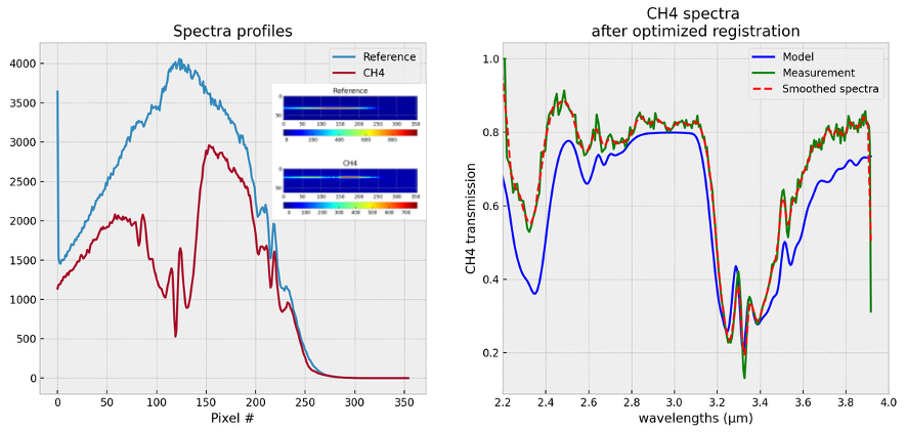
The measurement procedure is straightforward. Two acquisitions are performed with AIRS : the first with methane in the optical path, and the second without methane, serving as a reference. By taking the ratio of the two measurements, the methane spectrum obtained with AIRS can be compared with a theoretical model.
The figure below shows, on the left, the raw spectra from the reference measurement and the methane-cell measurement, and on the right, the comparison between the measured spectrum and the theoretical model. The excellent agreement between the two suggests that the instrument is performing nominally.
French contribution to the ARIEL mission
France is making a major contribution through the provision of the AIRS (ARIEL Infra-Red Spectrometer) infrared spectrometer. The instrument is being developed under the leadership of CEA-Irfu (Department of Astrophysics, AIM Joint Research Unit), with major contributions from IAS (Institut d’Astrophysique Spatiale), LIRA (Laboratory for Instrumentation Research in Astrophysics), and LAB (Laboratoire d’Astrophysique de Bordeaux). CNES serves as the contracting authority. IAP (Institut d’Astrophysique de Paris) and LISA (Laboratoire Interuniversitaire des Systèmes Atmosphériques) will also contribute to the scientific preparation of the mission through simulations and data-processing pipelines.
