A high-stakes orbital insertion
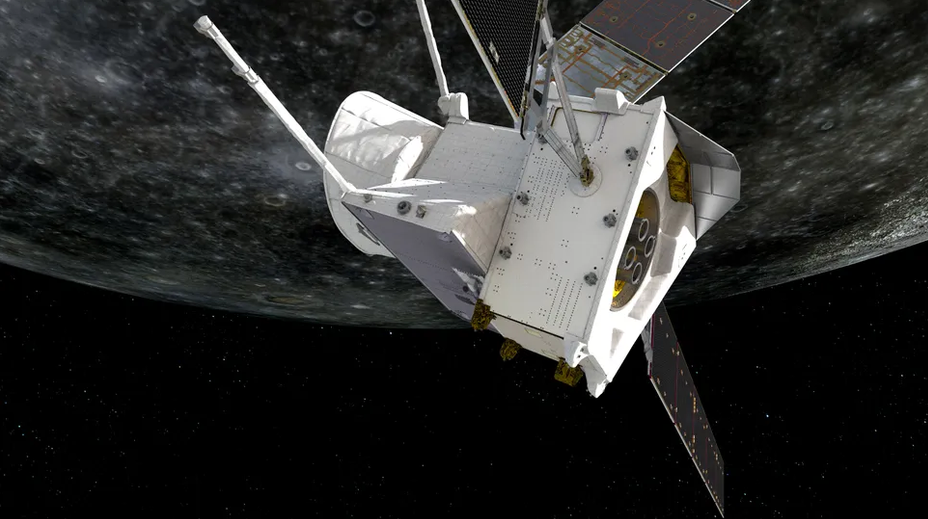
Launched in October 2018 from Kourou, the BepiColombo mission, led by ESA in collaboration
with JAXA, is nearing its goal.
On 3 September 2026, the Mercury Transfer Module (MTM) was separated from the two orbiters (see our news itemon the separation of the Mercury Transfer Module). Since then, MPO has been providing propulsion for the entire assembly on its own, replacing the MTM’s ion engines. Mio remains attached to its top.
On the 21st of November, BepiColombo is due to be captured by Mercury’s gravity to enter a polar orbit around the planet. To achieve this, the probe must first slow down sufficiently, which has required one flyby of Earth, two of Venus and six of Mercury.
Since September 2026, the ESA has been relying on a capture technique known as weak stability boundary capture, utilising MPO’s chemical propulsion system.
The arrival will mark the start of a sequence of around fifteen delicate manoeuvres designed to gradually refine the trajectory.
Months of preparation

Since the separation from the MTM, the teams have been hard at work. On 15 September, all
of MPO’s instruments were successfully switched on for the first time in this configuration
(see our news item on the first image from SIMBIO-SYS).
On 24 September, MPO tested its main thrusters for 8 minutes and 42 seconds, performing a
trajectory correction with a thrust of 11.4 m/s.
Finally, on 29 October, the ESA control centre in Darmstadt completed a series of simulations
of the mission’s various activities, repeating each stage of the arrival whilst incorporating
various scenarios to account for unforeseen events.
LIRA’s instruments at the forefront
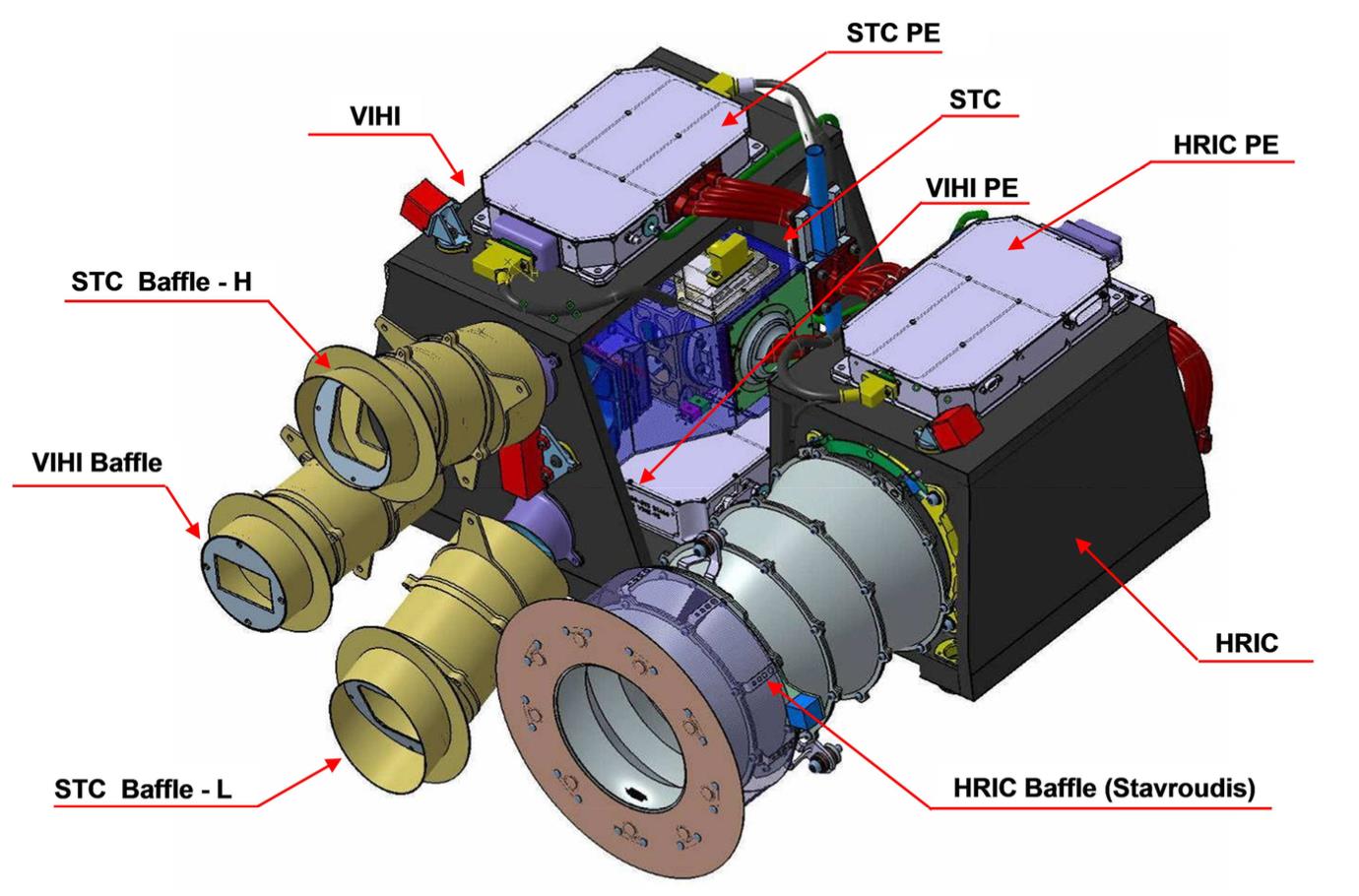
On board MPO, the VIHIspectro-imager, part of the SIMBIO-SYS suite, will map the mineralogical composition of Mercury’s surface between 400 and 2000 nm. On board Mio, the SORBET, which forms part of the PWI experiment, will study the planet’s magnetosphere and its interaction with the solar wind using radio frequencies for the first time.
Two orbiters around Mercury
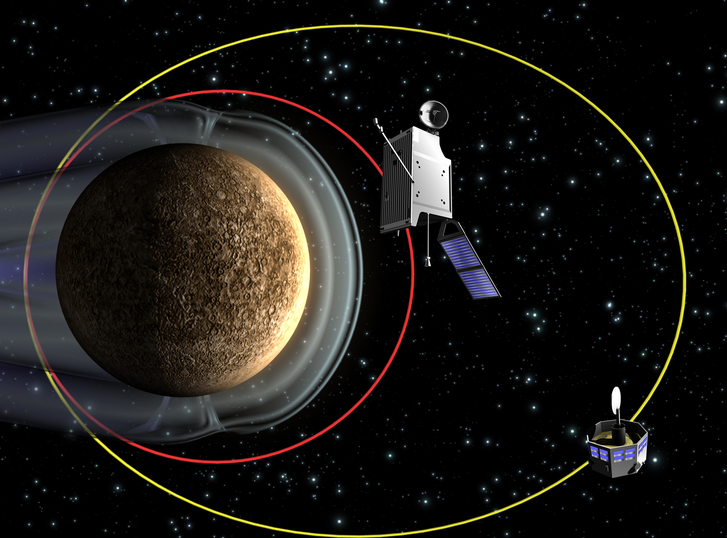
BpiColombo will be the first mission to place two probes into orbit around Mercury
at the same time. After capture, MPO and Mio will remain attached for a few weeks
before separating.
Two orbiters with very different orbits will enable the study of both Mercury’s surface and
interior, as well as its magnetic field and plasma environment, to gain a better
understanding of the formation of planets close to their star, including Earth.