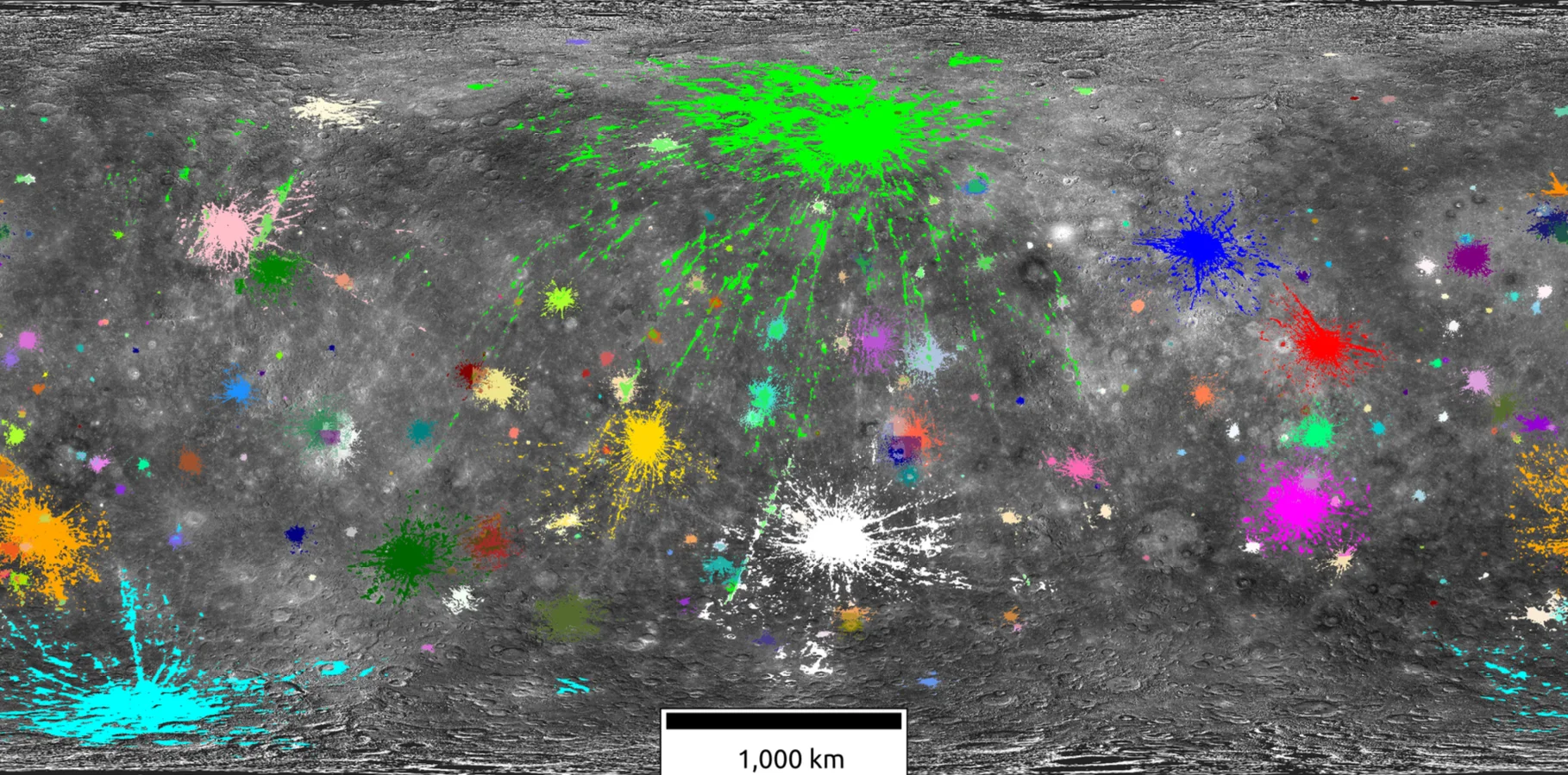
On Mercury, some young impact craters are surrounded by bright, filamentary “rays” : ejecta made of relatively immature material excavated by the primary impact and by secondary impacts. Over time, space weathering (micrometeoroid bombardment and solar-wind irradiation) darkens these deposits and the rays fade, making them a useful indicator of geologically young surfaces (hundreds of Myr). In his PhD work at LIRA, Michele Lissoni developed a deep-learning approach that combines a connection model (is a tile linked to a crater by a ray ?) with a segmentation model (where is the ejecta ?), trained on the global MDIS Enhanced Color mosaic at 665 m/pixel. The resulting global product overlays ejecta masks from many craters—each in a different color—opening the door to systematic studies of ray geometry, spectral properties, crater ages, and impact dynamics.
Deep-learning maps of fresh crater rays on Mercury
25 May 2026