
In 2025, the European Research Council is funding 349 researchers in Europe through its ERC Consolidator Grants, with a total of €728 million from the Horizon Europe framework program.
Supporting the best in exploratory research in all fields, these grants reward European project leaders who obtained their doctorate between 7 and 12 years ago. Consolidator grants (up to €2 million) fall between Starting grants (up to €1.5 million and 2 to 7 years after a PhD) and Advanced grants (up to €2.5 million and aimed at established researchers). They are awarded once a year for a period of five years to scientists from all over the world, but who must carry out their research in a European or associated country.
In total, 11.2% of the 3,121 projects proposed were funded in 2025. The 215 male and 134 female winners will carry out their projects in universities, research centers, and companies in 25 European countries, including the United Kingdom (66 grants), Germany (58), the Netherlands (40), Spain (26), and France (25).
However, ERC President Maria Leptin said she was impressed by the creativity and audacity of the projects submitted : "To see all this talent with groundbreaking ideas, based in Europe, is truly inspiring. This bold research may well lead to new industries, improve lives and strengthen Europe’s global standing. This was one of the most competitive ERC calls ever, with record demand and also many excellent projects left unfunded. It is yet another reminder of how urgent the call for increased EU investment in frontier research has become".
ECHOES - Exploiting Coherence in High-contrast Observations of ExoplanetS
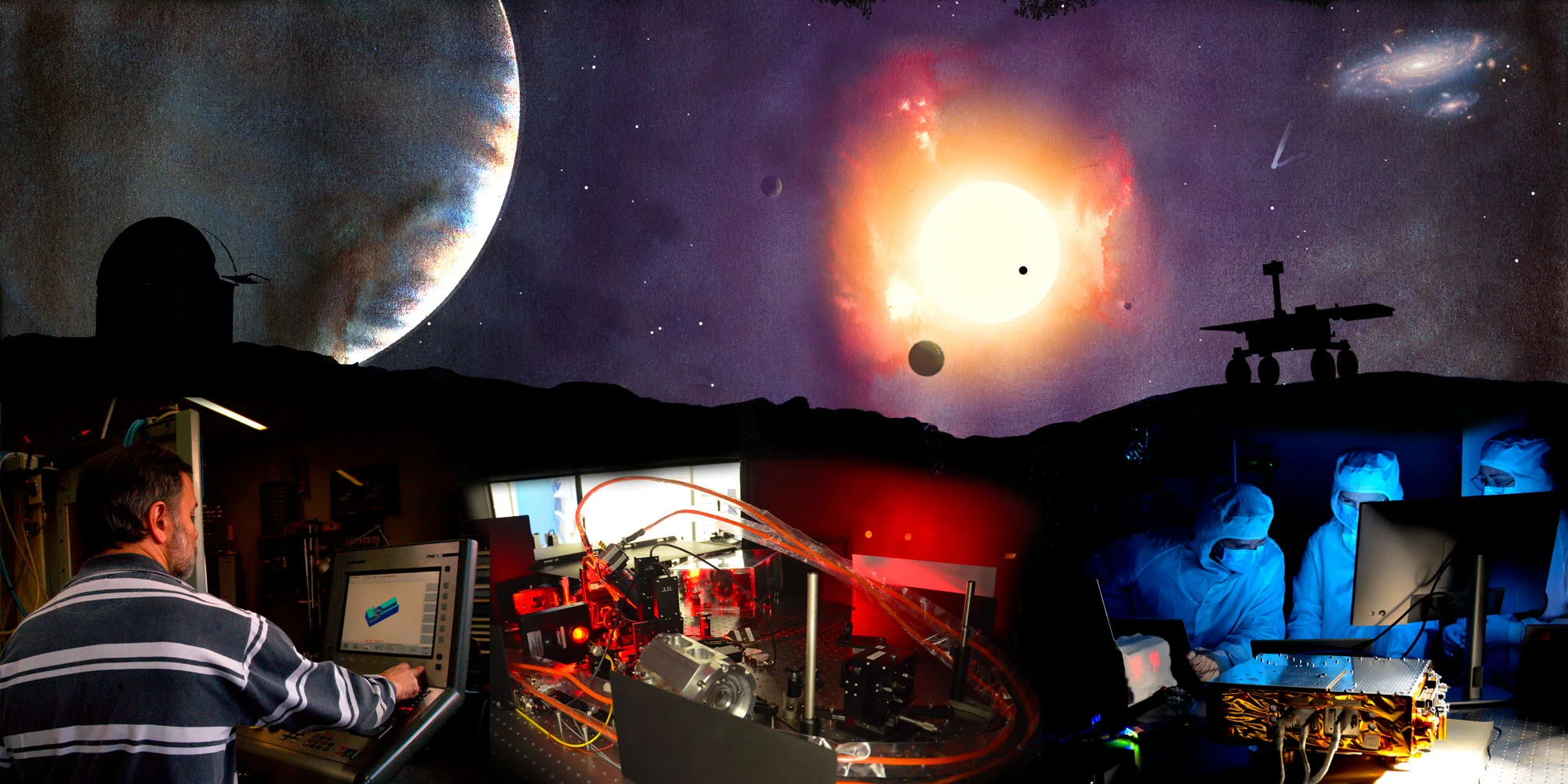
Among the winners, Johan Mazoyer, a CNRS researcher at LIRA, received a grant for his project "ECHOES - Exploiting Coherence in High-contrast Observations of Exoplanets." He specializes in optics for astronomy and high-contrast imaging of exoplanets, with the aim of understanding the evolution of exoplanets and planetary systems.
The transit method currently dominates exoplanet discovery but is limited to short-period, transiting planets. offering only partial nsights into habitable zone (HZ) planets. Direct imaging, particularly hrough coronagraphic imaging, presents the most promising approach for characterizing HZ exoplanets and their atmospheres. Future missions like NASA’s Habitable Worlds Observatory (HWO) and ELT instruments, such as the Planetary Camera & Spectrograph (PCS), aim to overcome this challenge, targeting HZ planets around Sun-like and M-dwarf stars, respectively. However, coronagraphic imaging faces significant obstacles due to the extreme star-planet flux ratios. To limit the risks faced by PCS and HWO, ESO and NASA have initiated two technology demonstrators, VLT/SPHERE+ (2027) and Roman mission (2026). They will validate innovative active wavefront correction methods, key to improve coronagraphic performance.
As of today, current coronagraphs instruments have uncovered only a handful of young giant planets (YGPs). But radial velocity surveys suggest most YGPs orbit closer (5-10 au), currently right at the limit of our instruments" capability. The upcoming Gaia release (2026) will provide hundreds of possible targets.
The positioning SPHERE+, a technology demonstration with cutting edge performance, is a unique opportunity to address a dual goal :
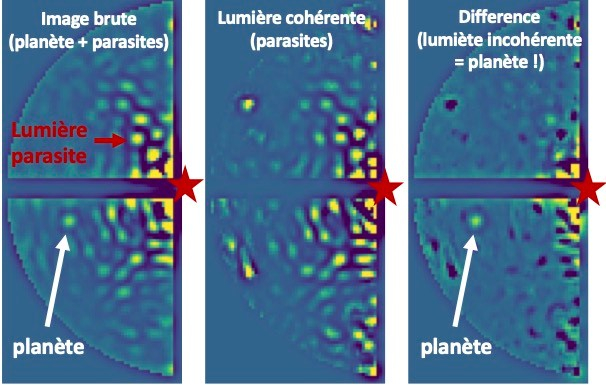
- Astrophysical : Imaging already indirectly detected Y GPs using the novel "dark-hole" technique
- Instrumental : Developing faster active wavefront correction methods and image treatment
The methods developed through this ERC are unexplored and have been specifically chosen to be relevant for ground and space instruments. They will be tested on SPHERE+, serve as a foundation for the design of ELT/PCS, and could be used on Roman, with a long-term goal of direct use for HWO. Finally, a key deliverable is to provide an experimental platform for PCS & HWO technology demonstration, open to European researchers for collaboration.
Plus d’informations
Contact : Johan Mazoyer
