22 janvier 2026Par Benjamin Charnay, Johan Mazoyer, Vincent Coudé du Foresto, Sylvestre Lacour, Pierre Kervella, Anne-Marie Lagrange, Françoise Roques, Philippe Thébault, Quentin Kral, Philippe Zarka
The study of exoplanetary systems has become a major theme in astronomy. Their great diversity provides us with a new perspective on our solar system and the possibility of life on other worlds. The characterization of exoplanetary systems and exoplanetary atmospheres aims to constrain the formation and evolution processes that lead to this diversity and control the habitability of planets.
The coming decade will be a key period in this adventure, thanks to the convergence of many instruments dedicated primarily or largely to exoplanets. Members of the Exoplanetary Systems group at LIRA work on instrumentation, observation, and modeling aspects of exoplanets, disks, and star-exoplanet relationships.
ESA / NASA
Observation and Instrumentation
.
High-Contrast Imaging
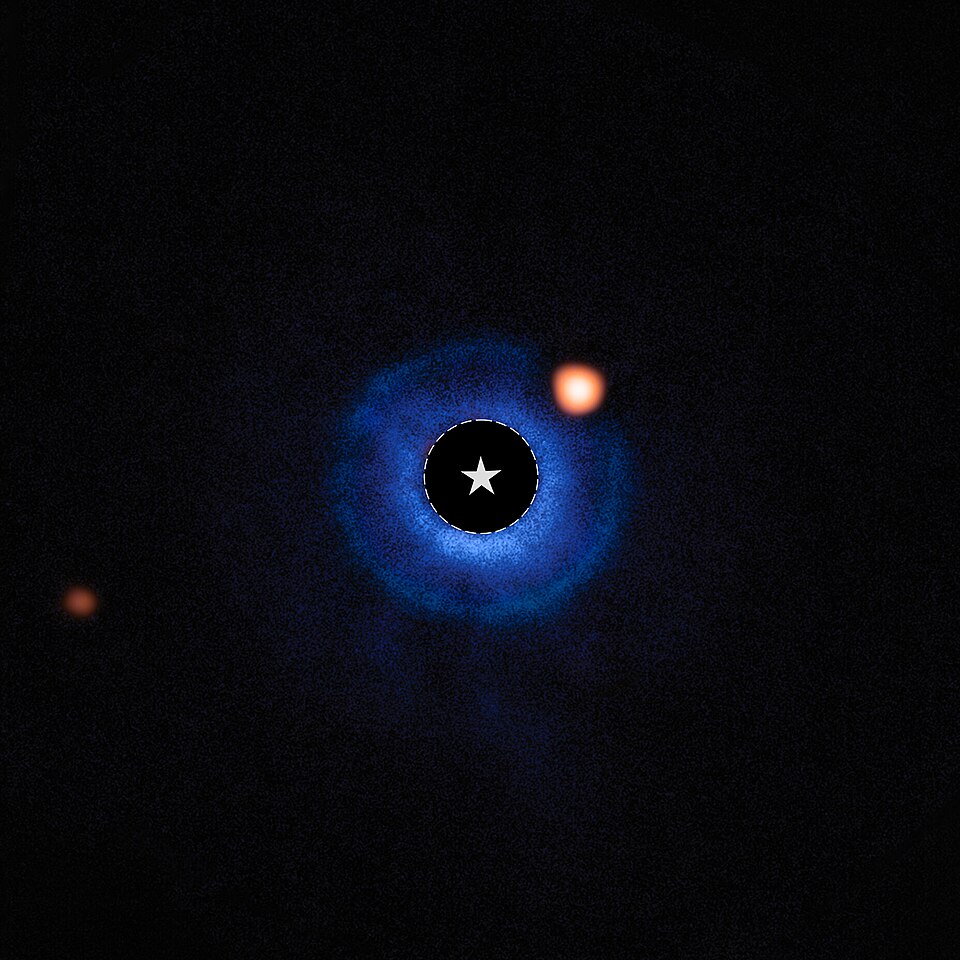
Webb image of planet TWA 7 b / Image Webb de la planète TWA 7 b
ESA/Webb, NASA, CSA, A.M. Lagrange, M. Zamani (ESA/Webb)
If a planet is difficult to observe directly, it is not only because it is intrinsically faint, but also because the observer is "blinded" by the star’s light. Coronagraphy is a technique that masks the star’s light to reveal the planet’s image. To work from the ground, this technique must be combined with adaptive optics (another major research focus at LIRA), which compensates for atmospheric turbulence and significantly improves coronagraph performance. LIRA is involved in several coronagraphic instruments to detect and characterize young giant exoplanets and circumstellar disks, including participation in JWST-MIRI, the VLT-SPHERE instrumen, and its future upgraded version,SPHERE+(PI : A. Boccaletti), and the coronagraphic channel of MICADO the first light instrument of the ELT. The ERC projet Cobrex (PI : A.-M. Lagrange) aims to develop new techniques for analyzing high-contrast imaging data for these instruments.
Following a robust R&D program, new techniques are constantly being developed at LIRA. For these developments, LIRA has a unique coronagraphic test bench in Europe, the THD2 testbed (PI : P. Baudoz). The ERC project ECHOES (PI : J. Mazoyer) aims to push these R&D developments to invent the techniques necessary for the next generation of coronagraphic instruments. Contacts : P. Baudoz, A. Boccaletti, r. Galicher, A.-M. Lagrange, J. Mazoyer, A. Potier
Interferometry
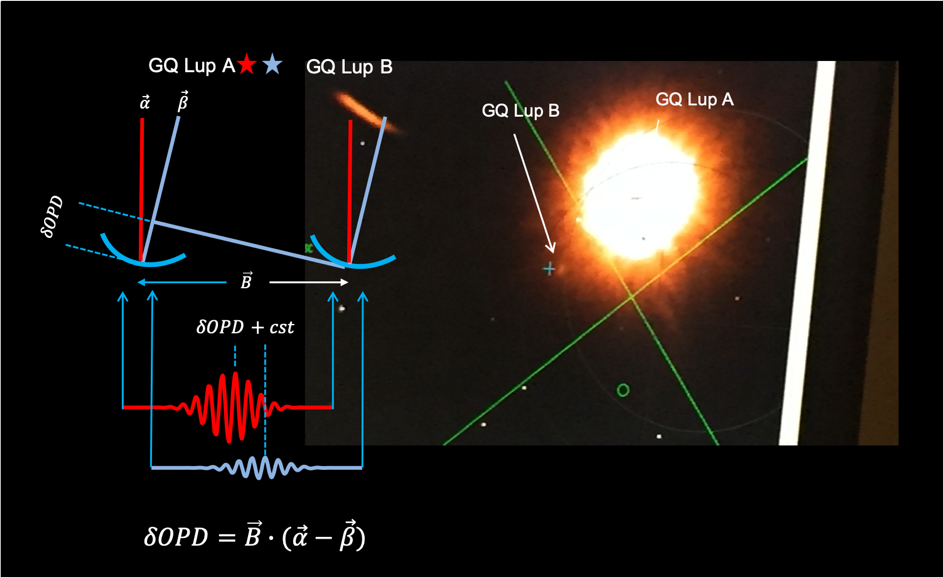
Principe de l’interférométrie
A gauche : séparation des franges d’interférences entre l’étoile et l’exoplanète. A droite : observation avec GRAVITY de la naine brune QG Lup B.
The LIRA teams contributed to the construction of the GRAVITY instrument, an optical interferometer installed on Mount Paranal, Chile. This interferometer combines the light from four 8-meter "UT" telescopes, effectively creating a "super-telescope" with the angular resolution of a 120-meter-diameter telescope. Our team was responsible for the first detection of an exoplanet by interferometry and uses this instrument to precisely measure the positions of exoplanets, track their orbits, analyze their atmospheres, and study the interactions of exoplanets in multiple systems. We are also developing new interferometric instruments within our group, focusing particularly on observing the H-alpha emission from accreting protoplanets (instrument FIRST, PI Huby). The group was also heavily involved in the GRAVITY+ upgrade and lead the exoplanet program of this instrument, ExoGRAVITY. Finally, ERC project PLANETES (PI : S. Lacour) aims at increasing the resolution of GRAVITY to reach even closer exoplanets. Contacts : S. Lacour, E. Huby, M. Nowak
Transit
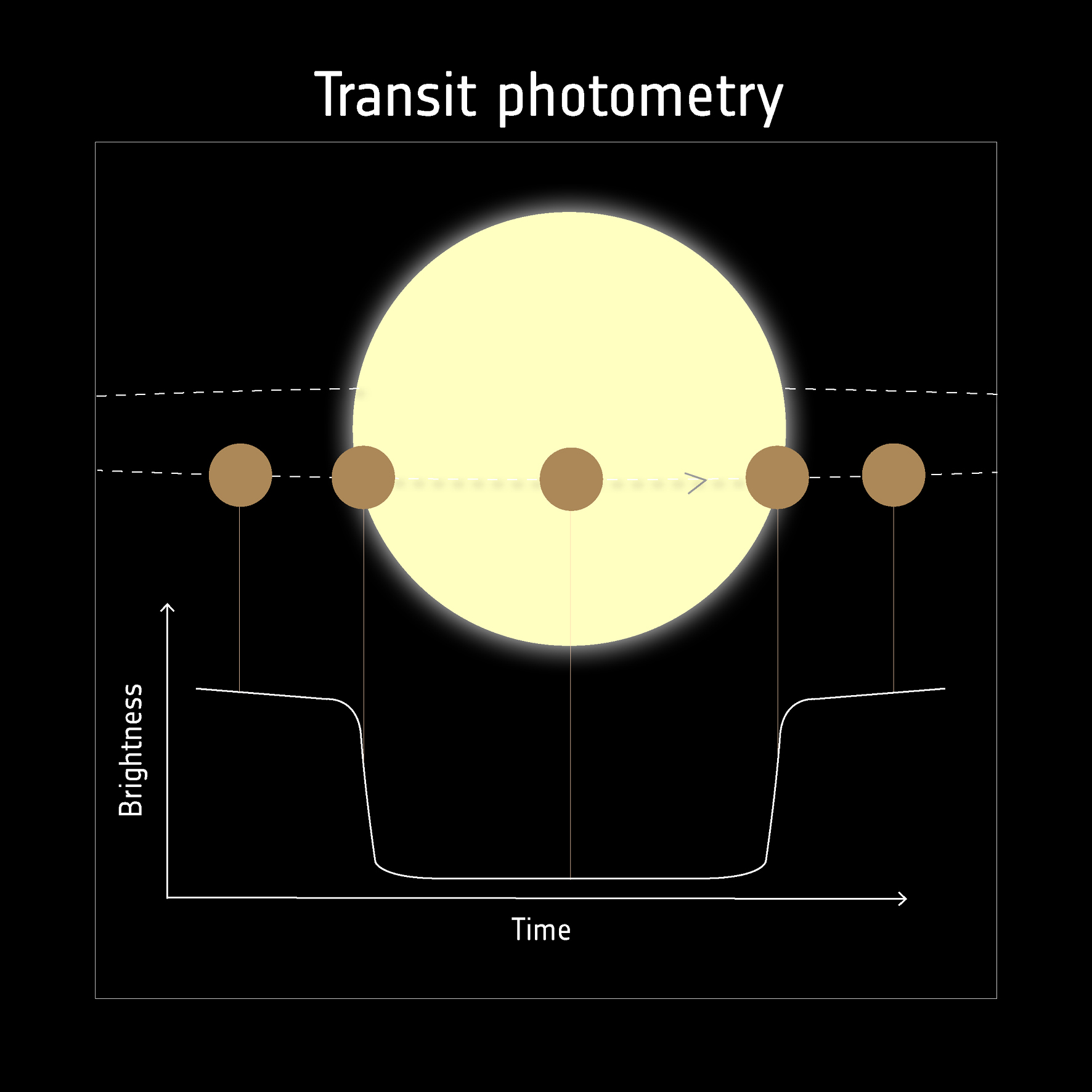
Principle of expolanet transit / Principe du transit exoplanétaire
ESA
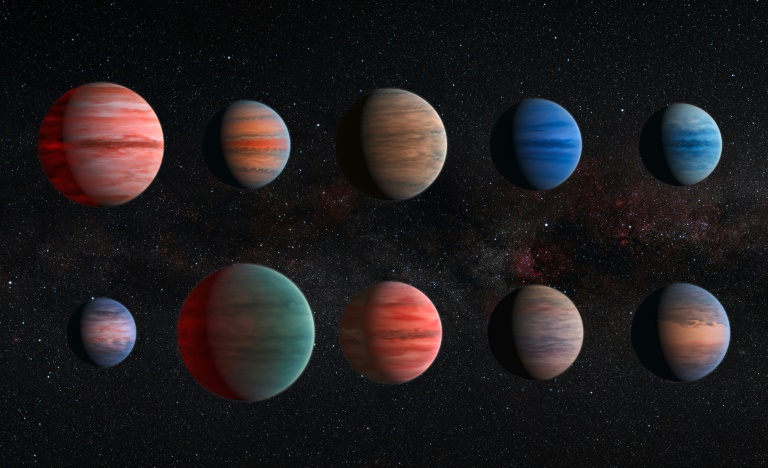
If the plane of a planet’s orbit around its star includes the observer’s line of sight, the planet will pass in front of the star’s disk during each revolution, resulting in a periodic partial occultation of the star. This phenomenon, called a transit, can be used to indirectly deduce the presence of a planetary companion and measure its diameter. The CoRoT satellite and the PicSat nanosatellite were emblematic programs of this research at LIRA. The PLATO project, initially designed at LIRA and selected as an ESA-M3 mission, will discover and characterize planetary systems comparable to our solar system. Transit spectroscopy involves measuring the apparent variations in an exoplanet’s radius with wavelength to characterize its atmosphere. This method is currently widely used with JWST and will be central to the ESA-M4 mission Ariel (scheduled for launch in 2029), for which LIRA is responsible for calibration (lead by B. Charnay). We also apply high-resolution transit spectroscopy techniques from the ground using instruments like CFHT-SPIRou and VLT-CRIRES. Contacts : B. Charnay, E. Ducrot, S. Vinatier, V. Coudé du Foresto, E. Michel
Radial Velocity and Astrometry ; Multi-Technique Approach
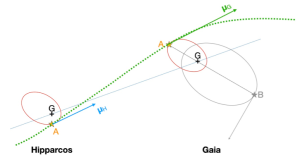
Principe de la détection d’exoplanètes par astrométrie
Trajectoire apparente sur le ciel (courbe en vert) d’une étoile (A) possédant une planète (B). Les deux objets orbitent autour de leur centre de masse (G). Les mesures de mouvement propre par Hipparcos et Gaia montrent un changement de vitesse de déplacement de l’étoile.
(cliquer pour agrandir)
The velocity of a star, both in projection on the sky (proper motion) and along the line of sight (radial velocity), is affected by the presence of orbiting companions. Stars with one or more planets exhibit a trajectory in space with slight oscillations, while single stars move in a straight line. Combining astrometric measurements of proper motion from European satellites Gaia and Hipparcos with radial velocity measurements (obtained via spectroscopy) allows for the detection of a planet around a star and, in some cases, the estimation of its orbital parameters and mass. In some cases, we can go further by combining this information with imaging data (e.g., VLT-SPHERE) or precise relative position measurements from the GRAVITY instrument to improve the quality of the orbital parameters obtained and the determination of planetary masses. Contacts : A.-M. Lagrange, P. Kervella, F. Kiefer
Radio Emission
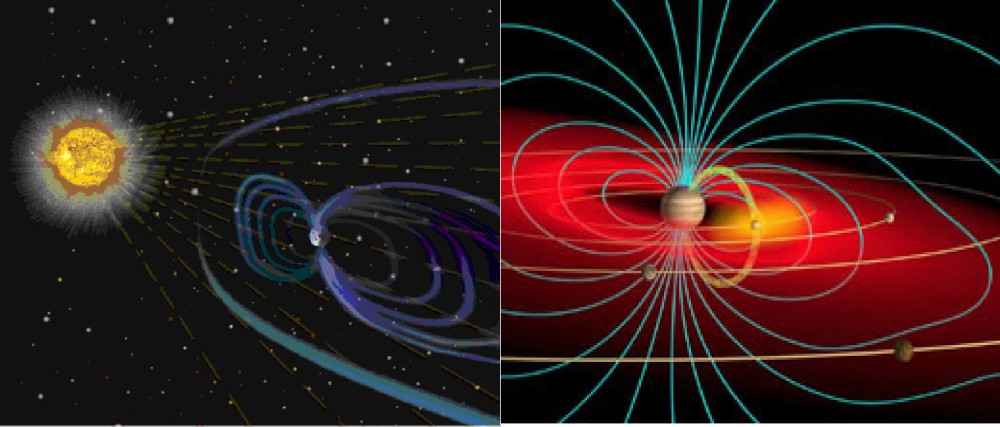
Emission radio décamétrique
Interactions soleil-magnétosphère et Jupiter-satellites (cliquer pour agrandir)
The giant planets of the solar system, particularly Jupiter, have strong magnetic fields and emit intense low-frequency radio radiation. This radiation, produced by charged particles accelerated in the magnetospheres of these planets, is almost as intense as solar emissions at the same wavelengths (decametric). Extrasolar giant planets could therefore reveal their presence through this radiation. Theoretical studies suggest this could be the case for hot Jupiters (giant planets orbiting very close to their star). The most promising planetary systems are observed by several teams using the world’s largest low-frequency radio telescopes. Potentially exoplanet-related signals have been detected but require confirmation. The prospects soon offered by NenuFAR (in France) and SKA (low frequencies, in Australia) are promising. Direct detection of radio emission will provide a direct measurement of the planetary magnetic field and rotation period and open the promising field of comparative study of magnetospheres and star-planet "plasma" interactions. This is at the core of the ExoRadio ERC program. Contacts : Philippe Zarka, Louis Corentin, Laurent Lamy
Modeling
Circumstellar Disks
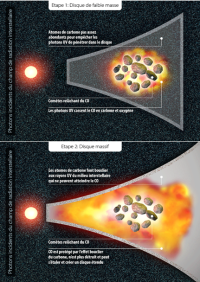
Production et évolution du CO dans un disque de débris
(cliquer pour agrandir)
In many planetary systems, circumstellar disks of material not used in planet formation persist, such as the asteroid or Kuiper belts in our solar system. Studying these debris disks is of paramount importance because their evolution and structure are intimately linked to those of the system’s planets, while often being more easily observable than the planets themselves. For two decades, LIRA has developed leading expertise in the numerical modeling of these disks. This expertise is structured around three main axes : 1) the collisional study of debris disks, using a statistical code that has helped understand the link between observed dust and the total reservoir of solid matter ; 2) the coupling between dynamical and collisional evolution, using the DyCoSS and LIDT-DD codes, which have enabled detailed studies of interactions between disks and planets or stellar companions ; and 3) the study of the gaseous component of these disks, with models exploring both the gas production rate and its observability (e.g., with ALMA), as well as models tracking the thermodynamic, physicochemical, and hydrodynamic evolution of this gas. Recent studies also allow tracking the accretion of this gas by already-formed planets and its potential consequences on their atmospheres. Contacts : Q. Kral, P. Thébault
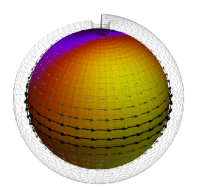
Exoplanets provide a fantastic laboratory for studying atmospheric processes under conditions very different from those of the solar system’s planets. Analyzing atmospheric chemical composition also provides insights into planetary formation and evolution mechanisms, as well as habitability and potentially the presence of life on the surface of an exoplanet. The LIRA exoplanet team is involved in developing 1D and 3D models of exoplanet atmospheres. The goal is to include key physical/chemical processes that control atmospheres in these models to interpret observations via transit spectroscopy or direct imaging. We developed the 1D model Exo-REM, initially to interpret SPHERE observations of young giant exoplanets. This model has been extended to exoplanets observed in transit and to the study of thermal evolution and the interiors of exoplanets. We also participate in the development of the 3D Generic Planetary Climate Model (Generic PCM), which we apply to the study of exoplanet and brown dwarf atmospheres, as well as to the climates and habitability of early Earth and terrestrial planets. Contacts : B. Charnay, B. Bézard
Scientific Outreach and service to the community
Exoplanet.eu
The Extrasolar Planets Encyclopedia (exoplanet.eu), created in 1995 (the year the first exoplanet was discovered), contains a database of exoplanet properties and their star(s) (approximately 70 parameters, including mass, radius, orbital, and atmospheric parameters), information on ongoing research (bibliography, conferences, observation campaigns), and interactive tools (diagrams, planet observability, planetary system stability, atmosphere simulator). It catalogs objects up to 60 Jupiter masses : The portal also lists molecules detected in atmospheres, associated disks, and planets of binary stars. Planets can be confirmed or candidates. Maintained for now 3 decades at Paris Observatory, this site is intended for researchers as well as the general public seeking accessible and reliable information. Contacts : Q. Kral, F. Roques
Sciences for Exoplanets and Planetary Systems
"Sciences for Exoplanets and Planetary Systems" is a digital book on planetary sciences at the undergraduate level, equivalent to 250 hours of coursework. The goal is to provide open access to the latest knowledge on exoplanets, as well as the methods and tools used by researchers to build this knowledge. These open-access resources, under a Creative Commons license, are intended for students and teachers in higher education, as well as anyone wishing to understand research in (exo)planetology. This content forms the basis of the online course program Lumières sur l’Univers-Sciences Planétaires. Contact : F. Roques
Permanent members of the Exoplanetary Systems group (name, status, research interest)
Nicole Allard, DR CNRS emeritus, Stellar and planetary atmospheres
Pierre Baudoz, adjunct-astronomer, High-contrast instrumentation
Bruno Bézard, DR CNRS emeritus, Atmospheric Modeling / Transit
Anthony Boccaletti, DR CNRS, High-contrast imaging